

In this article: A practical, room-by-room guide to choosing the right leather sofa — from sizing and configuration to material selection and what to test before you commit.
- Start With the Room, Not the Sofa
- Choosing the Right Configuration for Your Space
- Material and Finish: Which Leather Type Fits Your Lifestyle
- Comfort Factors That Matter After the First Hour
- What to Ask the Retailer Before You Buy
- Frequently Asked Questions
Choosing the right leather sofa for your space is less about finding the most beautiful option and more about matching a specific piece to your actual room dimensions, daily habits, and long-term care commitment. The wrong choice — even a beautiful one — creates friction every time you walk into the room.
This guide takes a decision-first approach: start with your room constraints, then narrow by configuration, then refine by material and comfort. Reverse the order and you'll likely end up with a sofa you love in a setting that doesn't work.
Quick Takeaways
• Measure and tape the floor before visiting a showroom.
Knowing your exact constraints — length, depth, clearance — turns a 2-hour shopping trip into a targeted decision.
• Configuration determines traffic flow, not just seating.
An L-shape or sectional that blocks the main walking path is more disruptive than a slightly smaller sofa that doesn't.
• Protected leather is the right default for most households.
Aniline leather is beautiful but unforgiving. Unless you can commit to careful daily habits, a pigmented or semi-aniline finish delivers beauty with practical durability.
• Sit for at least 15 minutes in your actual usage position.
Sofa comfort at 2 minutes is not the same as sofa comfort at 90 minutes. Test it the way you'll use it.
• Seat depth is the most underrated spec.
A sofa that's too deep leaves shorter users' feet dangling; too shallow feels perched. Test depth in person — it's hard to evaluate from dimensions alone.
1. Start With the Room, Not the Sofa

Before looking at any sofa, answer these four questions about your room:
What is the available wall length?
Measure the wall or zone where the sofa will go. Subtract 18–24 inches from each end for breathing room — a sofa pressed wall-to-wall looks cramped and makes moving around it awkward. If you have windows, doors, or vents along the wall, account for those too.
What are the main traffic paths?
Trace the routes people typically walk through the room: from the entry to the kitchen, from the living area to a hallway, etc. Your sofa should not block or narrow these to less than 36 inches. For secondary paths (between sofa and coffee table), 18 inches is the minimum comfortable clearance.
What is the viewing direction?
The sofa's primary orientation is toward whatever you most commonly watch, look at, or gather around — a TV, a fireplace, a window. A sofa angled away from the main visual focus makes every use feel slightly off.
Can a sectional work?
Mark the L-shape footprint on the floor with painter's tape. Stand in the room for a few minutes and walk around it. If it obstructs traffic or makes the room feel overwhelmed, scale down. If it feels natural and leaves comfortable clearance, you have your answer before visiting a showroom.
2. Choosing the Right Configuration for Your Space

Standard 3-seat leather sofa
The most versatile configuration. Works in rooms of almost any size, can be repositioned easily, and doesn't define traffic flow the way a sectional does. Best for formal living rooms, apartments, or any space where the furniture arrangement might change seasonally.
Sofa with chaise
The midpoint between a standard sofa and a full sectional. Adds lounging space without the full footprint of an L-shape. The chaise orientation is typically fixed — confirm left- or right-facing before ordering based on your room layout and the direction most people will sit.
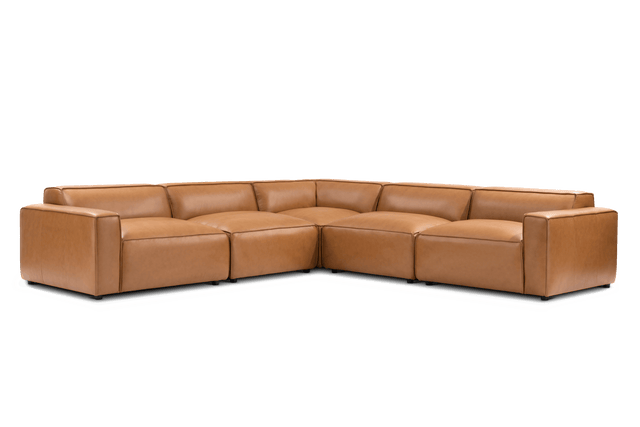
L-shape sectional
Best for family rooms and media rooms where maximum seating and a defined zone are priorities. Requires room for the corner without blocking traffic. The return section can face different directions — orient it toward walls rather than traffic paths.
Modular leather sectional
The most flexible option if you move frequently or want to change the layout over time. Individual sections connect via hardware — look for integrated brackets rather than adjacency-only designs that shift during use.
3. Material and Finish: Which Leather Type Fits Your Lifestyle
For families with children and pets: protected (pigmented) leather
The most forgiving finish for busy households. The protective topcoat resists spills, oils, and light abrasion. Cleans easily with a pH-balanced leather cleaner. Less breathable than aniline, but the practical trade-off is significant in high-contact rooms.
For adults in lower-traffic households: semi-aniline leather
The balance between natural beauty and practical durability. Lightly protected — enough to resist everyday oils and light spills, but with enough natural grain to develop a subtle patina. The most common finish in premium Italian Nappa leather furniture.
For collectors of natural materials: full grain or aniline leather
The purest leather experience. No protective topcoat means maximum breathability, the most natural feel, and the most visible patina development. Requires consistent care — oils, spills, and even prolonged contact with dark clothing can mark aniline leather. Not recommended for households with children or pets.
What to avoid: bonded and PU leather
Both look like leather initially but behave like a coated surface. Bonded leather peels and flakes at high-contact points within a few years. PU leather can last slightly longer but lacks the durability, feel, and aging characteristics of genuine hide. Neither is recommended for primary living room seating intended to last a decade or more.
4. Comfort Factors That Matter After the First Hour

Seat depth
Measure from the front edge of the cushion to the back cushion: 20–22 inches suits most users sitting upright; 23–26 inches accommodates lounging. If you're shorter than 5'6", test deeper seats carefully — feet that don't reach the floor change posture and increase lower back strain over long sessions.
Seat height
Standard sofa seat height is 17–19 inches. Lower seats feel more casual and lounge-like; higher seats are easier to stand up from. For anyone with knee or hip issues, 18–19 inches is the easier range for getting in and out.
Back cushion support
Back cushions should support the lumbar without pushing the upper body unnaturally forward. Sit upright with your back against the cushions and notice whether your lower back feels supported or hollowed out. Very soft back cushions look plush but may require a lumbar pillow for extended sessions.
Arm height
Low arms allow more flexible seating positions; high arms create a more traditional enclosure. If you tend to lounge sideways on a sofa, low arms (21–24 inches from floor) are more comfortable. If you use the sofa primarily upright for watching TV, arm height matters less.
5. What to Ask the Retailer Before You Buy
• What is the leather grade and finish — full grain, top grain, semi-aniline, or pigmented?
• What is the frame material — specifically kiln-dried hardwood, and what species?
• What is the foam density rating, and is it high-resilience (HR) foam?
• What does the warranty cover, and for how long — frame, leather, and cushions separately?
• Can a leather swatch be provided before purchase?
• What are the delivery dimensions of the fully assembled piece vs the sections it ships in?
• What is the return or exchange policy if the sofa doesn't fit or the color reads differently in my room?
Frequently Asked Questions
How much space do I need between my sofa and coffee table?
The recommended distance between a sofa and coffee table is 14–18 inches. This allows comfortable reach across the table without needing to lean far forward, while leaving enough room to cross your legs or shift position. Less than 12 inches feels cramped; more than 20 inches requires leaning forward uncomfortably to use the table.
What is the most durable leather for a family sofa?
For family households, a protected (pigmented) top grain leather in a medium to dark tone offers the best practical combination of durability, stain resistance, and ease of cleaning. The protective finish resists everyday oils, spills, and light abrasion better than aniline or semi-aniline finishes — the trade-off is a slightly less natural feel and less visible patina development over time.
Should I buy a sofa in person or online?
In person if possible — at minimum, request a leather swatch before committing. Sofa color and leather texture are nearly impossible to evaluate accurately from photographs alone. If purchasing online, choose a retailer with detailed material specifications (leather grade, foam density, frame material) and a reasonable return or exchange policy in case the color reads differently in your room.
How do I choose between a sofa and a sectional?
The main deciding factor is traffic flow, not personal preference. If the room needs to remain walkable through multiple paths, a standard sofa is less disruptive. If the room has a single primary gathering zone and a clear viewing direction, a sectional creates a better seating environment. Use painter's tape to mark the footprint of both options and live with the outline for a day before deciding.
What seat depth is right for me?
Test this in person. General guidance: if you're under 5'6", look for seat depths of 20–22 inches; 5'7"–5'11" is comfortable with 21–24 inches; taller users typically prefer 24–26 inches. For primarily lounging use (media rooms, home theaters), deeper is usually better. For primarily upright use (conversational living rooms), shallower seats keep posture natural.
How do I care for a new leather sofa?
Dust weekly with a soft microfiber cloth. Spot-clean monthly with a pH-balanced leather cleaner on a cloth. Condition every 3–6 months — only when the leather actually feels dry or looks dull, not as a routine. Keep the sofa at least 18 inches from heat sources and direct sunlight. Avoid alcohol-based products, all-purpose cleaners, and silicone sprays.
