

In this article: The complete guide to buying a leather sofa — what the grade terms actually mean, how construction determines longevity, which configurations work for different rooms, and what to ask before you buy.
- Leather Grades Explained: Full Grain, Top Grain, and Bonded
- Frame and Suspension: What Holds a Leather Sofa Together
- Sofa Styles: Choosing the Right Configuration
- What to Look For When Shopping In Person
- Leather Sofa vs Sectional: Which Suits Your Room
- Frequently Asked Questions
A leather sofa is one of the longest-lasting upholstered furniture investments you can make — with a quality piece lasting 15–25 years versus 5–10 for most fabric alternatives. But that longevity depends almost entirely on three decisions: leather grade, frame construction, and configuration. Get these right and the color and style choices become secondary.

This guide covers what you need to know at each stage of the buying process — from understanding what "top grain" and "full grain" actually mean in practice, to what to look for when sitting in a sofa at a showroom, to how to choose between a standard sofa and a sectional for your specific room layout.
Quick Takeaways
• Full grain leather is the most durable and develops the richest patina.
Top grain is more uniform and easier to maintain. Bonded leather is a composite — not genuine hide — and ages poorly in high-contact seating.
• Kiln-dried hardwood frames outlast particle board and undried wood by a decade or more.
The frame is the part you can't see — ask specifically about materials and joinery before purchasing.
• High-resilience foam rated 1.8 lb/ft³ or higher holds its shape through years of daily use.
Standard foam compresses permanently and seats lose support within 2–3 years of heavy use.
• Test comfort in the showroom the way you'll actually use it.
Sit for at least 10–15 minutes in your normal position — reclined, upright, sideways. Sofa comfort changes after the first few minutes.
• Measure your room with the actual product dimensions before ordering.
Use painter's tape to mark the footprint — this eliminates the most common leather sofa purchasing regret.
1. Leather Grades Explained: Full Grain, Top Grain, and Bonded

The leather grade describes how much of the hide's natural structure remains after processing. This affects feel, durability, and how the leather ages — not just the initial appearance.
Full grain leather
The top layer of the hide with its natural grain left completely intact. No sanding or buffing to remove surface irregularities — which means natural markings, variations, and pores may be visible. This is the most durable grade because the original fiber structure is preserved. Develops the richest patina over time. Best for buyers who want a leather that visibly ages and improves with use.
Top grain leather
Real leather that has been lightly sanded or buffed to remove surface irregularities, then finished for a consistent look and feel. More uniform in appearance than full grain. The finishing process adds a protective layer that makes it somewhat more resistant to stains and easier to maintain. Most premium sofas and sectionals in the $1,500–$5,000+ range use top grain leather.
Bonded leather
Not genuine hide in the traditional sense — it's a composite of leather fiber scraps mixed with polyurethane binder and applied to a backing. Can look similar to leather at first but typically shows peeling, cracking, or flaking within 3–5 years of regular use in high-contact zones. Not recommended for daily-use living room seating.
Italian Nappa leather
A processing style rather than a strict grade designation — typically refers to full grain or high-quality top grain hides tanned in Italy using traditional methods that emphasize exceptional softness. The specific tannery, tanning method, and finish all affect performance. See our guide on Italian Nappa leather for a detailed breakdown.
2. Frame and Suspension: What Holds a Leather Sofa Together

Kiln-dried hardwood frames
The benchmark for quality sofa construction. Controlled kiln drying reduces moisture content before the wood is used in construction, minimizing warping, joint movement, and the squeaks that follow. Premium sofas with 10–25 year warranties typically use kiln-dried hardwood (often maple, ash, or beech).
Particle board and MDF frames
Common in budget sofas. Particle board lacks the continuous fiber structure of solid wood and has limited screw-holding strength — fasteners loosen over time. Joints flex, then fail. Not recommended for high-use living room seating.
Suspension systems
• Sinuous (S-shaped) springs: the modern standard — efficient and adequate for most residential seating.
• Eight-way hand-tied springs: more labor-intensive, associated with highest-end upholstery, provide even weight distribution and longer-lasting support.
• Webbing or flat-panel support: common in lower-cost designs — provides less give and tends to compress faster.
What to look for in joinery
Corner blocks, dowels, and adhesive reinforcement are signs of quality frame construction. Staples-only joinery loosens faster under the repeated loading of daily use — particularly in arm attachment points and seat deck corners.
3. Sofa Styles: Choosing the Right Configuration
| Style | Best for | Minimum room size |
|---|---|---|
| Standard 3-seat sofa | Apartments, formal living rooms, rooms that need to stay walkable | 10 × 12 ft |
| L-shape sectional | Family rooms, media rooms, open plan living with defined zones | 10 × 13 ft |
| U-shape sectional | Large family rooms where the sofa is the room's central piece | 12 × 15 ft |
| Sofa and loveseat | Traditional arrangements, rooms with two traffic paths | 12 × 14 ft |
| Sofa with chaise | Lounging-forward rooms with one dedicated seating area | 10 × 12 ft |
4. What to Look For When Shopping In Person
The sit test (15 minutes minimum)
Sit in your actual usage position for at least 15 minutes. Sofa comfort changes significantly after the first few minutes when foam and spring tension settle under your weight. If you primarily recline, recline. If you sit upright to watch TV, sit upright. A sofa that's comfortable for 2 minutes isn't necessarily comfortable for 2 hours.
Frame flex test
With both hands, press down on the seat frame corners. A small amount of give is normal. Visible flex or movement in the arm or back frame is a sign of inadequate joinery — this movement becomes a squeak within months of daily use.
Leather quality check
Run your hand across the leather surface: genuine full grain leather has a slightly irregular texture with subtle variation. Look at seams — tight, consistent stitching with no loose threads. Smell the leather: real leather has a distinctive earthy, warm scent; synthetic materials often smell of chemicals.
Cushion density test
Press the seat cushion firmly with your palm. Quality HR foam springs back quickly and evenly. Standard foam that returns slowly or unevenly will compress permanently faster under regular use.
5. Leather Sofa vs Sectional: Which Suits Your Room
The choice between a standard sofa and a sectional depends more on traffic flow and room function than on personal preference.
Choose a standard sofa if:
• The room needs to function as a pass-through (multiple traffic paths across the room).
• You want the flexibility to rearrange furniture without committing to a corner configuration.
• The room is under 10 × 12 feet, or a sectional would leave less than 36 inches of clearance for main walking paths.
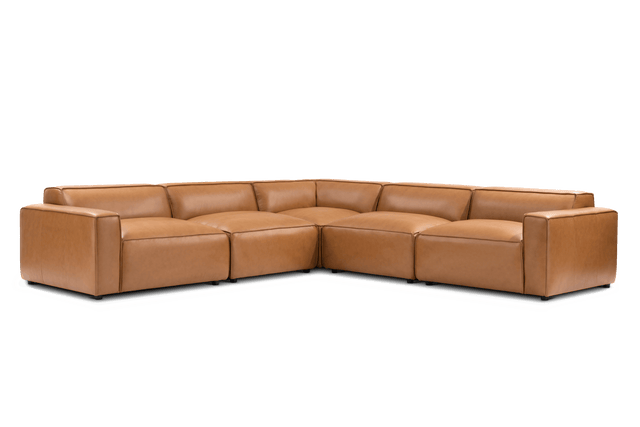
Choose a sectional if:
• You want maximum seating capacity in a dedicated family room or media space.
• The room has one primary traffic path and a clear viewing direction (like a home theater setup).
• You entertain frequently and need seating that brings more people into the same conversation zone.
Frequently Asked Questions
How long does a leather sofa last?
A well-built leather sofa with a kiln-dried hardwood frame and genuine top grain or full grain leather can last 15–25 years with proper care. Budget leather sofas with particle board frames and bonded leather typically show significant deterioration within 3–7 years. The frame is usually the first failure point; the leather outlasts most frames when cared for correctly.
Is top grain leather worth the price premium over bonded leather?
Yes — significantly, for daily-use furniture. Top grain leather maintains its integrity through years of contact; bonded leather begins to peel and crack at high-contact points (seat edges, arm caps, headrests) typically within 3–5 years of regular use. Over a 10-year ownership period, the per-year cost of a quality top grain sofa is often lower than replacing a bonded leather piece twice.
What is the best leather sofa for a family with pets?
A protected (pigmented) top grain leather in a medium to dark tone is the most practical choice for pet households. The protective finish resists surface scratches better than aniline leather, pet hair wipes off easily, and medium to dark tones are more forgiving of everyday marks. Avoid aniline leather — it's beautiful but shows oils and marks much more readily than protected finishes.
How do I know what size leather sofa to buy?
Measure the specific wall or zone where the sofa will go, then mark the footprint with painter's tape on the floor. Allow at least 18 inches of clearance on sides the sofa doesn't face, and at least 36 inches for main walking paths. The tape test is far more reliable than estimating from room dimensions alone.
Should I buy a leather sofa online or in person?
If possible, see and sit in the piece before purchasing — or at minimum, request a leather swatch. Online photography and screen color rendering rarely match how leather actually looks in a room under your specific lighting conditions. If purchasing online, look for retailers with generous return policies and detailed specifications on leather grade, frame material, and foam density.
What is a fair price for a quality leather sofa?
A genuine top grain leather sofa with a quality frame and HR foam cushions starts at approximately $1,500–$2,500 for a 3-seat configuration. Full grain and Italian Nappa leather add a significant premium. Sofas priced significantly below $1,000 in "leather" are almost universally bonded leather or PU — the economics of sourcing and tanning genuine hide make lower prices very difficult for quality furniture.
What is the most comfortable leather sofa?
The most comfortable leather sofa combines high-resiliency foam rated 1.8 lb/ft³ or higher, a kiln-dried hardwood frame with a properly tensioned spring system, and a chaise or sectional configuration that lets you fully stretch out rather than sit upright. A deep seat with a lower back cushion tends to feel more comfortable for lounging than a firm, shallow-seated formal sofa. The sit test above (15 minutes minimum, in your actual usage position) is the only reliable way to judge comfort for your body and your room.

