

In this article: A practical budget breakdown for every home theater component — from entry-level to premium — so you spend wisely and avoid common over- and under-investment mistakes.
- Display: TV vs. Projector
- Audio: Where the Experience Lives
- Seating: The Component You Use Every Session
- Room Treatment & Acoustics
- Where to Put Your Money First
- Frequently Asked Questions
A complete home theater build ranges from $4,000 for a well-chosen single-row setup to over $100,000 for a purpose-built dedicated room. Most people land somewhere between $8,000 and $25,000 — and where you spend matters more than the total.

This guide breaks the budget into its five real categories, gives honest price ranges at each tier, and explains which categories to prioritize and which can wait. For seating-specific guidance, see the How to Choose Home Theater Seats guide.
Quick Takeaways
• Seating returns the highest long-term value per dollar.
Divide the cost by years of use and it's the cheapest seat in the house — don't cut it short.
• Audio is the category where cuts hurt most.
Poor sound kills immersion faster than image quality ever will.
• Projectors need darkness; TVs don't.
Your room's light control should drive the display decision more than specs.
• Run wiring at installation.
Retrofitting wires after construction costs 5–10 times more.
• Room treatment is the most underinvested category.
DIY panels at $300 outperform a $3,000 audio upgrade in an untreated room.
1. Display: TV vs. Projector

The display is the most visible budget line item and the source of most early mistakes. The key question isn't "TV or projector" — it's whether your room can go dark.
| Tier | Budget Range | What You Get |
|---|---|---|
| Entry | $800–$2,000 | 4K projector with basic screen, or 85"+ 4K TV. Solid image quality for most rooms. |
| Mid-Range | $2,000–$5,000 | Dedicated home theater projector with quality ALR screen, or 98"+ premium TV. HDR performance improves significantly. |
| Premium | $5,000–$20,000+ | Reference-grade laser projection (JVC, Sony, Epson LS), high-gain screen. Native 4K, exceptional black levels. |
Projector advantages: Screen sizes of 100"–150" at lower cost, true cinematic feel, less eye strain in dark rooms. Projector disadvantages: Requires near-total darkness, lamp/laser maintenance, longer setup path.
TV advantages: Works in any room lighting, no installation, plug-and-play.
TV disadvantages: Capped at 98"–110" for most models, higher cost per inch at large sizes.
The practical decision: if you can blackout the room and commit to a proper screen wall, a projector at $2,000–$4,000 outperforms a TV at twice the price on perceived screen size and cinematic quality. If the room has uncontrolled light or you want a simpler setup, a 75"–85" premium TV is the right call.
2. Audio: Where the Experience Lives

Audio has a disproportionate impact on how immersive a home theater feels. Most people underinvest here — and they notice it immediately during action sequences and quiet scenes alike.
| Tier | Budget Range | What You Get |
|---|---|---|
| Entry | $500–$1,500 | Soundbar with wireless subwoofer, or basic 5.1 receiver + bookshelf speakers. Significant improvement over TV audio. |
| Mid-Range | $1,500–$5,000 | Quality AV receiver (Denon, Marantz, Yamaha) + 5.1 or 7.1 floor-standing speakers. Atmos-capable at the top of this range. |
| Premium | $5,000–$30,000+ | Full Dolby Atmos 9.1.4+ configuration with height channels and dedicated subwoofers. True cinema reference performance. |
The single most impactful audio upgrade at any tier is adding a quality subwoofer. Low-frequency extension changes the physical feel of the content. After that, the room treatment (see Section 4) has more impact on sound quality than equipment upgrades in the same price range.
One practical note: run HDMI and speaker wire during construction. Pulling wires after walls are finished costs 5–10× more. Even if the audio system is entry-level at first, lay conduit for the premium system you'll eventually want.
3. Seating: The Component You Use Every Session

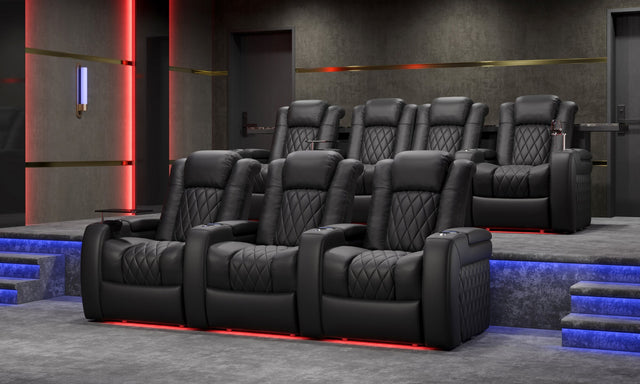
Seating is the only component in a home theater that makes physical contact with you for the entire session. A $1,500 seat used 200 times per year over 10 years costs $0.75 per use. A $3,000 seat under the same math costs $1.50 per use — less than a bag of microwave popcorn.
| Tier | Budget Range | What You Get |
|---|---|---|
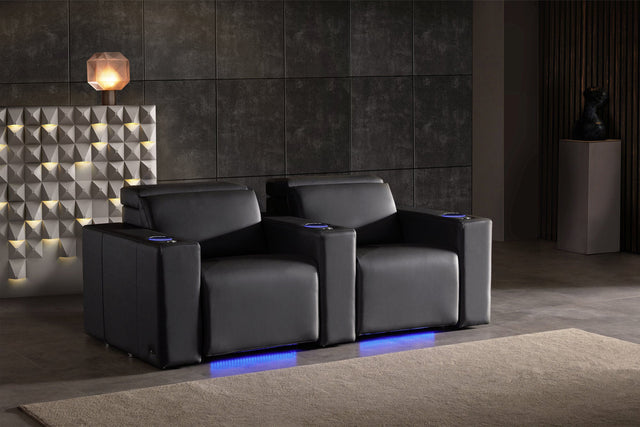
| Entry | $800–$2,500 | Row of 2 with power recline, basic leather or fabric. Functional comfort without premium features. |
| Mid-Range | $2,500–$6,000 | Row of 2 or 3 with power recline, power headrest, heat, massage, Italian leather. Full comfort feature set. |
| Premium | $6,000–$15,000+ | Multiple rows, all seats with full feature packages, premium Italian Nappa leather, riser configuration. |
The features that have the most daily impact: power recline (smooth, any position), power headrest (critical for long sessions), and heat (you use it constantly once you have it). For a full breakdown of which features are worth the cost, see Home Theater Seating Features That Actually Matter.
4. Room Treatment & Acoustics

Room treatment is consistently the most underbudgeted and underappreciated category in home theater design. An untreated room with hard walls and no absorption will make a $10,000 audio system sound worse than a $2,000 system in a treated room.
| Tier | Budget Range | What You Get |
|---|---|---|
| Entry | $200–$800 | DIY fabric-wrapped acoustic panels, blackout curtains, thick area rug. Meaningful improvement for minimal cost. |
| Mid-Range | $800–$3,000 | Commercial acoustic panels, bass traps in corners, diffusers on rear wall, bias lighting system. |
| Premium | $3,000–$15,000+ | Professional acoustic design, custom-built panels and diffusers, engineered bass control, dedicated HVAC for the room. |
At the entry level, DIY fabric-wrapped panels (2" Rockwool or OC703, wrapped in acoustically transparent fabric) perform nearly identically to commercial equivalents costing 5× more. Four panels in the first reflection points — the two side walls at ear height — make a noticeable difference in $500 of materials.
Blackout capability also determines your display choice. Blackout curtains or motorized shades ($200–$1,000) transform a bright room into one that can support a projector, essentially doubling your display options without upgrading the projector itself.
5. Where to Put Your Money First

The order in which you invest matters. Some things are hard to change after the room is built; others are easy upgrades any time.
Non-negotiable at installation: Run all wiring — HDMI, speaker wire, conduit for future runs — before walls close. This is a $200–$500 investment during construction that saves $2,000–$5,000 in retrofitting costs later. Seating and room treatment decisions also have long lead times and affect the design of everything else.
Best first investments:
• Seating and wiring infrastructure — hardest to change post-construction, highest long-term use value.
• Room treatment basics — $300–$800 in DIY acoustic panels returns more than $3,000 in audio equipment in an untreated room.
• Subwoofer — the single most impactful audio purchase regardless of budget tier.
• Display size over display brand — a 100" screen at mid-tier image quality beats a 65" screen at premium quality for cinematic impact.
What can wait: Projectors and TVs improve fastest and are easiest to swap out. Audio components can be added incrementally — start with a quality 5.1 system and add Atmos height channels later. Upgrade display when the current one actually limits your experience, not on a schedule.
For more on planning a two-row theater, see the Do You Need a Theater Riser guide. For room layout planning, see the Layout & Row Spacing Guide.
Frequently Asked Questions
What's a realistic budget for a good home theater?
For a single-row setup with good image, audio, and seating, plan for $8,000–$15,000. A two-row dedicated theater with premium components typically runs $20,000–$40,000. Below $5,000 you can build something functional, but compromises will be noticeable. See the complete breakdown in the Complete Guide to Home Theater Seating.
Should I buy a projector or a TV?
If you can fully control room lighting, a projector gives more screen per dollar and a more cinematic feel. If the room has windows or ambient light you can't eliminate, a bright TV is the better choice. Screen size matters more than image quality at equivalent budgets — a 100" projection image beats a 65" TV for immersion even if the TV has slightly better specs.
What's the minimum I should spend on audio?
$1,000–$1,500 is the minimum for a system that does justice to a proper home theater setup. At this price you can get a capable AV receiver and 5.1 speaker set that delivers real surround sound. A quality subwoofer in the $300–$600 range is the highest-impact single purchase — prioritize it over more expensive speakers in the same budget.
Is DIY acoustic treatment worth it?
Yes. Fabric-wrapped panels using 2" Rockwool or OC703 insulation perform comparably to commercial panels at a fraction of the cost. Four panels at the first reflection points (side walls at ear height) for $400–$600 in materials will improve sound clarity more noticeably than upgrading speakers in the same price range. Blackout curtains and a thick area rug provide additional meaningful improvement.
Should I phase the build or buy everything at once?
Phase strategically. Do seating, wiring infrastructure, and basic room treatment in phase one — these are hardest to change later. Display and audio components can be upgraded incrementally as technology improves and budgets allow. Don't defer seating to save money; the long-term cost-per-use math makes it one of the best values in the build.
How much should I spend on seating specifically?
For a two-seat row, $2,500–$4,500 puts you in quality home theater chairs with power recline, power headrest, heat, and Italian leather. This is the mid-range tier where features meaningfully improve daily comfort. Going lower means sacrificing features you'll notice every session. Our How to Choose Home Theater Seats guide covers this in detail.
What component gets upgraded most often?
Displays. TVs and projectors improve in technology and drop in price faster than any other category. Seating and acoustic treatment rarely get upgraded once chosen correctly. Audio falls in the middle — AV receivers update every 3–5 years as new audio formats emerge, but good speakers last 15–20 years. This is why prioritizing seating and room treatment early makes financial sense.
Is there a good ratio to use for allocating budget across categories?
A common starting point: 30% display, 25% audio, 30% seating, 15% room treatment. In practice, seating is often underweighted. Given that seating is the component with the highest daily contact and the best long-term value retention, spending at or above the 30% mark on home theater seating is well-supported by actual usage patterns.