

In this article: Everything you need to buy a sectional sofa confidently — from choosing the right configuration and size to understanding materials, frame quality, and what to avoid.
- L-Shape vs U-Shape vs Modular Configurations
- How to Size a Sectional for Your Room
- Frame Materials: What Actually Holds It Together
- Cushion Fill and Comfort Over Time
- Fabric vs Leather Sectionals
- Frequently Asked Questions
Buying a sectional sofa is one of the highest-impact decisions in a living room. The right configuration anchors the space and defines how the room functions; the wrong one creates awkward traffic flow, poor seating sightlines, or a piece that looks oversized and out of scale.

This guide walks through the four decisions that matter most: configuration, sizing, frame quality, and upholstery. Get these right and the rest — color, accent pieces, layout — becomes much simpler to resolve.
Quick Takeaways
• Configuration first, then size.
Decide whether you need an L-shape, U-shape, or modular system before measuring — configuration determines how the sectional will define traffic flow and seating zones in the room.
• Leave 18 inches of clearance on all sides.
Sectionals that crowd walls or block doorways reduce usability and make the room feel smaller than it is.
• Kiln-dried hardwood frames outlast "solid wood" frames.
The drying process stabilizes the wood and reduces joint movement, squeaking, and warping over time.
• High-resilience foam holds shape longer than standard foam.
Look for seat cushions rated at 1.8 lb/ft³ or higher density for durability in daily-use seating.
• Leather and top-grain upholstery tend to outlast fabric in high-contact zones.
Fabric pilling and staining happens faster in seat and arm zones; leather develops a patina instead of wearing out.
1. L-Shape vs U-Shape vs Modular Configurations

L-shape sectionals
The most common configuration. One long face and one shorter return create a corner seating arrangement. Works in most room sizes and tends to leave more floor space than a U-shape. Best for rooms that need to remain walkable — living rooms with open floor plans or pass-through traffic.
U-shape sectionals
Three sides of seating that create an enclosed, conversation-forward arrangement. Requires significantly more floor space — typically 10 × 12 feet at minimum. Works best in large, dedicated family rooms or media rooms where the sectional is the room's defining piece and traffic flows around it rather than through it.
Modular sectionals
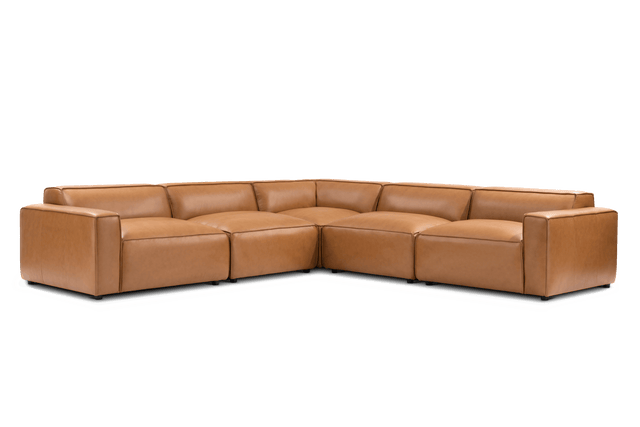
Individual seat units that attach or sit adjacent to each other and can be rearranged into different configurations over time. More flexible than a fixed L or U-shape, but the seating connection quality varies by brand. Look for interlocking brackets or connectors — seats that only sit adjacent without locking can shift during use.
Left-facing vs right-facing chaise
The "left" or "right" designation refers to orientation when you're seated and facing the sofa. Before ordering, stand in the room and decide which direction you want the chaise — this is a common source of ordering errors and cannot be corrected after purchase on most non-modular sectionals.
2. How to Size a Sectional for Your Room

The most common sectional sizing mistake is buying based on total linear length without accounting for clearance, traffic paths, and how the corner section occupies floor space.
Measuring correctly
• Measure the room and mark the footprint of the sectional with painter's tape on the floor before ordering.
• Allow a minimum of 18 inches between the sectional and any wall or furniture it doesn't face.
• Allow at least 36 inches for main traffic paths (hallways between furniture).
• Measure your doorways, stairwells, and hallways — sectional sections must fit through entry points on delivery day.
Depth and seat height
Sectional seat depth typically ranges from 22 to 28 inches. Deeper seats (25+ inches) are more comfortable for lounging but can be harder to sit upright in for shorter users. Seat height — typically 17–19 inches from the floor — affects how easy it is to stand up, which matters more than most buyers realize until after purchase.
Rug placement
For a sectional, the front legs of all sections should sit on the rug, or at minimum the front two legs of the longest face. A rug that's too small makes the sectional look unanchored and visually reduces the perceived size of both pieces.
3. Frame Materials: What Actually Holds It Together
The frame determines long-term structural stability — and it's the part you can't see after upholstery. Frame quality differences that seem minor in a showroom become obvious over years of daily use.
Kiln-dried hardwood
The most stable wood frame option. Controlled kiln drying reduces moisture content before construction, which minimizes the warping, shrinking, and joint movement that cause squeaks and structural loosening over time. Premium sectionals that carry a 10+ year warranty typically use kiln-dried hardwood frames.
Solid wood (not kiln-dried)
"Solid wood" sounds premium but is a broad category. Solid pine behaves very differently from solid maple — and even strong species can loosen over time if the lumber wasn't dried to the right moisture content before assembly. Ask specifically what species and whether it was kiln-dried.
Steel frames
Used frequently in reclining and motion sectionals because steel provides consistent geometry and strong anchor points for mechanisms. Quality depends on steel gauge and weld quality — thin steel or inconsistent welding creates weak points that fail under repeated reclining loads.
Frame joinery
Corner blocks, dowels, and adhesive reinforcement are signs of quality construction. Staples-only joinery — common in budget pieces — loosens faster under the repeated loading of daily use.
4. Cushion Fill and Comfort Over Time

High-resilience foam
The benchmark material for premium seat cushions. HR foam rated at 1.8 lb/ft³ or higher maintains its shape through years of daily use. Below that density, foam compresses permanently and the seat loses its support within 2–3 years of heavy use.
Foam wrapped in down or feathers
A premium combination: HR foam core for structure, wrapped in a thin layer of duck down or down alternative for a softer surface feel. Requires occasional refluffing but provides a more luxurious initial feel than foam alone.
Sinuous spring vs eight-way hand-tied springs
Sinuous (S-shaped) springs are the modern standard — efficient to manufacture and adequate for most seating. Eight-way hand-tied springs are more labor-intensive, traditionally associated with the highest-end upholstery, and tend to provide more even weight distribution across the seat deck.
5. Fabric vs Leather Sectionals
| Factor | Fabric | Leather |
|---|---|---|
| Durability (high-contact zones) | Pilling and abrasion in 3–7 years on cheap weaves | Develops patina; maintains structure longer in genuine hide |
| Stain resistance | Depends heavily on fabric treatment and weave density | Protected leather repels most surface spills if cleaned promptly |
| Temperature | Cooler to the touch; breathable weaves stay comfortable year-round | Can feel warm in summer, cool initially in winter; regulates to body temp |
| Maintenance | Slipcovers washable on some models; fabric may need professional cleaning | Weekly dust, monthly spot-clean, seasonal conditioning |
| Pet and child households | Pet hair embeds in fabric weaves; harder to remove | Pet hair wipes off leather; claws can scratch softer finishes |
| Longevity | 5–15 years depending on quality and use frequency | 15–25+ years with proper care for genuine leather |
Frequently Asked Questions
What size room do I need for a sectional sofa?
An L-shape sectional typically requires a room of at least 10 × 12 feet to allow for adequate clearance on all sides. A U-shape requires 12 × 14 feet or more. Use painter's tape to mark the exact footprint before purchasing — this is the most reliable way to confirm fit without guessing.
Can I put a sectional in a small living room?
Yes, but configuration matters. Compact L-shape sectionals in the 88" × 60" range can work in rooms as small as 10 × 11 feet. Look for low-profile designs without high-back cushions, which can visually overwhelm a smaller space. Modular sectionals offer the most flexibility for small rooms because you can start with fewer units.
Is left-facing or right-facing chaise better?
Neither is inherently better — it depends entirely on your room layout. Stand at the main entry of the room facing the sofa's position. The chaise should extend toward the longer wall without blocking traffic paths or the TV viewing angle. Sketch or photograph your room layout and mark the sectional footprint before deciding.
How long should a quality sectional sofa last?
A well-built sectional with a kiln-dried hardwood or heavy-gauge steel frame, HR foam cushions, and genuine leather upholstery should last 15–20+ years with regular care. Budget sectionals with particle board frames and standard foam typically show visible compression and frame weakness within 3–5 years of daily use.
Should a sectional sofa touch the wall?
It's common to place the back of a sectional against a wall, but the return section of an L-shape should have a few inches of clearance so it doesn't scrape paint or create a pinch point. Floating the sectional 2–4 inches from the wall also makes it easier to clean behind the piece and run cable management if needed.
How do I stop my sectional from sliding apart?
Most quality sectionals include connecting brackets or hardware that locks sections together. If yours doesn't, sectional sofa connectors (simple metal hooks that attach underneath) are available at furniture stores and online. A non-slip rug pad under the sectional also helps keep the entire piece in place on hard floors.