

In this article: A room-by-room breakdown of 8 popular living room design styles — what defines each one, and which sofa or sectional fits best.
- Modern Minimalist
- Scandinavian
- Mid-Century Modern
- Industrial
- Bohemian
- Coastal
- Traditional
- Transitional
- Frequently Asked Questions
Every living room tells a design story — and the sofa is usually its opening line. Whether you gravitate toward clean-lined minimalism, warm Scandi neutrals, or the layered richness of bohemian interiors, understanding the vocabulary of each style helps you make confident choices and avoid costly mismatch.

This guide decodes eight of today's most popular living room styles — covering the defining characteristics of each, the palette and materials that anchor it, and the sofa silhouette that pulls it all together.
Quick Takeaways
• Style is vocabulary, not a rulebook.
Understanding each style's defining traits lets you mix intentionally rather than accidentally.
• The sofa is the room's anchor.
Every style has a preferred silhouette — get the frame shape right and everything else follows.
• Materials carry as much weight as color.
Leather, linen, velvet, and bouclé each signal a specific design language before any color is chosen.
1. Modern Minimalist

Modern minimalism is defined by the deliberate removal of excess. Surfaces are clean, storage is hidden, and every object earns its place. The palette runs to white, off-white, concrete grey, and matte black — with texture introduced through natural materials rather than pattern.
Defining traits
• Low-profile furniture with visible legs or floating bases.
• Straight lines and right angles — no ornate curves or carvings.
• Monochromatic or two-tone palette with a single warm accent at most.
• Negative space used deliberately — the floor and wall are part of the composition.
Best sofa choice
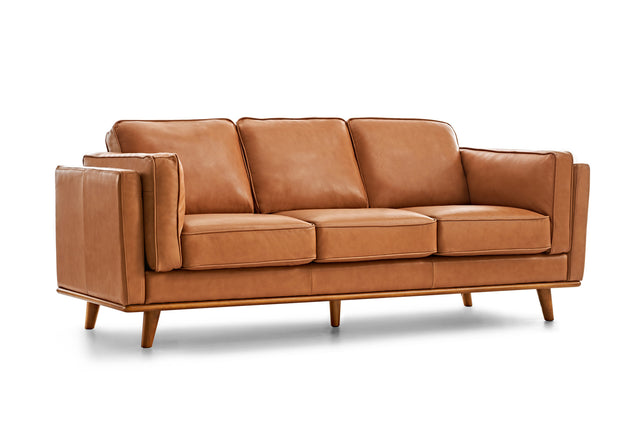
A tight-back, low-arm leather sofa with slim tapered legs and a clean rectangular silhouette. Avoid overstuffed cushions or visible welting. Top-grain black or graphite leather reads as sophisticated rather than stark in this context. Caramel and ivory leathers warm the palette without disturbing the discipline.
2. Scandinavian

Scandi design pursues a very specific balance: warmth through natural materials but discipline through restrained form. Light floods every corner via white or pale grey walls, blonde wood floors, and generous window treatments. The mood is cozy without being cluttered — what Danes call hygge expressed through the living room.
Defining traits
• Pale wood tones: birch, ash, light oak for floors, coffee tables, and shelving.
• Neutral wall colors: white, warm off-white, sage, or dusty blue-green.
• Natural textiles: wool, sheepskin, cotton, and linen layered for warmth.
• Plants, candles, and ceramics used as primary decorative elements.
Best sofa choice
A gently curved or slightly reclined sofa in a light ivory leather, warm taupe, or creamy white upholstery. Exposed blonde wood or brushed brass legs anchor it to the Scandi palette. Avoid high-gloss or very dark leathers — they break the soft, airy mood the style depends on.
3. Mid-Century Modern

Born from post-war optimism, mid-century modern (MCM) celebrates organic form, new materials, and the democratization of good design. It is characterized by low horizontal silhouettes, tapered legs, warm wood tones, and an earthy palette punctuated with burnt orange, avocado green, or mustard yellow.
Defining traits
• Walnut, teak, or rosewood furniture with tapered hairpin or dowel legs.
• Warm earth tones and jewel accents: terracotta, ochre, sage, teal.
• Gentle organic curves — tulip shapes, egg forms, and S-curves.
• Bold graphic rugs and abstract art used to anchor the palette.
Best sofa choice
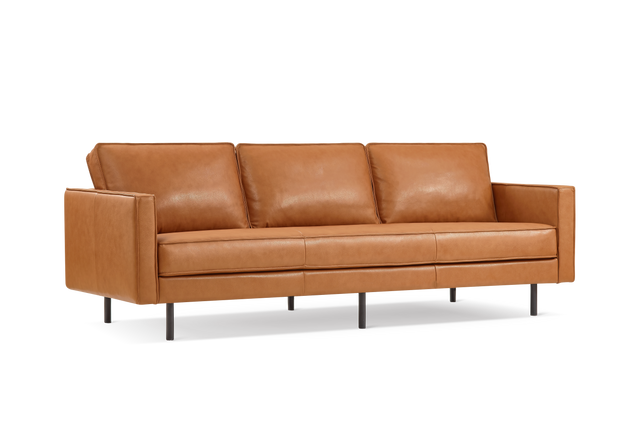
A low-back sofa with thin tapered wood legs and tight cushion seating in caramel, cognac, or warm tan leather. The leather should have visible grain and natural character rather than a corrected, uniform finish. A two-seater or compact three-seater proportioned to a single conversation area works best — MCM rooms do not favour oversized sectionals.
4. Industrial

Industrial design takes the exposed bones of warehouse and factory architecture — brick, raw concrete, aged steel, and reclaimed timber — and turns them into a living environment. The palette is deliberately dark and masculine: charcoal, black, rust, and aged brown, with matte finishes throughout.
Defining traits
• Exposed brick or concrete walls, Edison-bulb pendants, and black steel frames.
• Dark, aged, or distressed materials: reclaimed wood, blackened steel, raw leather.
• Oversized scale — high ceilings call for generously proportioned furniture.
• Minimal decorative accessories; utility objects double as art.
Best sofa choice
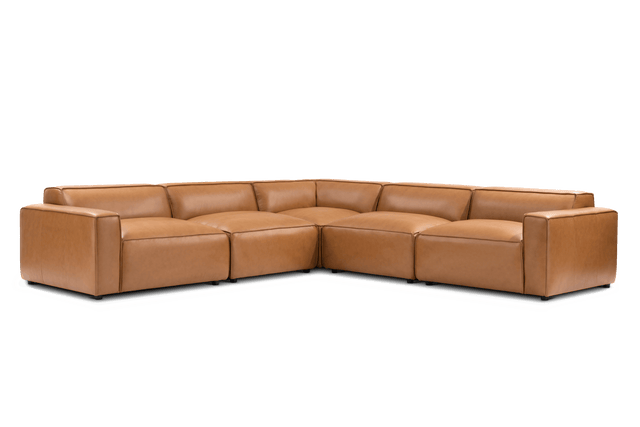
A large modular leather sectional in black, charcoal, or dark espresso — the kind that anchors the room rather than decorating it. Visible stitching, low arms, and a deep seat speak the industrial language. A corner sectional configuration turns an open loft layout into a defined zone without walls.
5. Bohemian

Bohemian interiors are organized around layering rather than coordination. Global textiles, vintage finds, and hand-crafted objects accumulate into a space that feels well-traveled and deeply personal. There is no single palette — the governing principle is saturation and warmth rather than matching.
Defining traits
• Layered rugs, throw blankets, floor cushions, and macramé wall hangings.
• Warm terracotta, saffron, dusty rose, burgundy, and forest green dominate.
• Rattan, cane, wicker, and unfinished timber alongside plush velvet upholstery.
• Plants in abundance — trailing vines, large-leaf specimens, and dried botanicals.
Best sofa choice
A generously proportioned sofa in cognac leather, warm tan, or even saddle-toned hide — leather ages beautifully in a boho room where patina is celebrated rather than hidden. Avoid anything too structured or corporate-looking; a slightly slouchy profile with removable cushions suits the relaxed spirit of the style.
6. Coastal
 Coastal style captures the relaxed, sun-washed atmosphere of a home near the ocean. It prioritises light, air, and natural texture over formal arrangement. The palette draws from sand, sea glass, driftwood, and sky — with crisp white as the constant backdrop.
Defining traits
• White or pale grey walls with natural linen, cotton, and jute textiles.
• Pale blue, seafoam, warm sand, and soft coral used as accents.
• Weathered or whitewashed wood, woven rattan, and sea-glass accessories.
• Natural light maximised — sheer curtains or plantation shutters rather than heavy drapes.
Best sofa choice
A slipcover-style or linen-blend sofa in white, oatmeal, or warm sand is the most authentic choice. If using leather, limit it to light ivory, parchment, or a very pale caramel — dark leathers feel too heavy and urban in a coastal room. Keep legs in white, natural driftwood, or light-washed finishes.
7. Traditional
 Traditional interiors draw from English, French, and American colonial design heritage. The defining qualities are symmetry, craftsmanship, layered pattern, and a sense of permanence. These rooms are meant to age gracefully rather than respond to trend cycles.
Defining traits
• Matched pairs — two armchairs, twin table lamps, flanking bookshelves.
• Rich jewel tones: navy, burgundy, forest green, and warm chocolate.
• Tufting, nail-head trim, carved wood details, and fringe or tassel accents.
• Patterned rugs — Persian, floral, or damask — as the room's foundation piece.
Best sofa choice
A Chesterfield or rolled-arm sofa in deep chocolate, cognac, or oxblood leather with visible tufting. The leather should look aged and rich, not lacquered or overly smooth. Cabriole or bun-foot legs in dark walnut or mahogany finish complete the period silhouette.
8. Transitional
 Transitional style resolves the tension between modern and traditional by blending the clean lines of contemporary design with the warmth and materiality of classic interiors. It is the most commercially popular style in North America precisely because it is the most accommodating — it works in nearly any floor plan, at any budget, in any home age.
Defining traits
• Streamlined furniture with subtle traditional references — track arms, simple tufting, or turned legs.
• Neutral backbone palette of warm grey, taupe, greige, and cream — with one or two textural accents.
• Mixed metals: brushed brass alongside matte black or nickel.
• Layered textiles that mix fabric weight rather than pattern.
Best sofa choice
Transitional is the sweet spot for a versatile leather sofa in a warm neutral — greige, warm taupe, caramel, or soft ivory. The arm style should be moderate height, neither the very high English roll arm nor the completely flat track arm. This is the style where a corner sectional works best for family living rooms, as it bridges generous seating with contemporary layout sensibility.
Frequently Asked Questions
Can I mix styles in one living room?
Yes — intentional mixing, often called eclectic design, produces some of the most interesting interiors. The key is picking a primary style for 70–80% of the room and using a secondary style as an accent. For example, a transitional room with mid-century accessories, or a Scandi room with one industrial pendant light. The sofa should belong to the primary style; accessories can stray further.
Which living room style is most timeless?
Traditional and transitional styles have the longest design lives because they do not reference any specific trend decade. Mid-century modern is also remarkably durable — it has been continuously popular since the 1950s. Modern minimalism, by contrast, can look dated as soon as one element falls out of fashion, because there is nothing else in the room to compensate.
What style works best for small living rooms?
Modern minimalist and Scandinavian styles both handle small spaces best because they prioritise light, low furniture silhouettes, and deliberate negative space. A pale Scandi sofa on tapered legs reads visually lighter than a dark skirted traditional sofa, making the room feel more open. Avoid industrial and bohemian in very small rooms — their scale and layering can overwhelm the space quickly.
Does the floor colour dictate my style choice?
The floor tone strongly suggests style direction but does not lock you in. Light blonde hardwood points naturally to Scandi and coastal. Dark walnut or ebony floors suit mid-century, industrial, and traditional interiors. Concrete or polished microcement reads as modern minimalist or industrial. You can counteract a floor's suggestion with other choices, but working with it is always easier than against it.
Is leather appropriate for every style?
Leather works in every style listed here — the tone and finish determine whether it fits. Full-aniline or semi-aniline leather in warm cognac or caramel reads as mid-century or bohemian. Corrected-grain leather in matte black or charcoal reads as industrial or modern minimalist. Light ivory or parchment leather belongs in coastal or Scandi. The grain visibility, finish sheen, and color temperature are the three variables to calibrate per style.
What defines transitional style versus contemporary?
Contemporary refers to what is current at any given moment — it is a moving target. Transitional is a stable design category that blends classic and modern elements in a specific, repeatable way. A transitional room in 2005 and one in 2025 will look similar; a contemporary room from 2005 looks firmly dated today. Transitional is the safer long-term investment for furniture you plan to keep for a decade or more.
How do I know which style matches my existing architecture?
Look at your moulding profiles, ceiling height, and window style first. High ceilings with large industrial windows point to industrial or modern minimalist. Low ceilings with deep crown moulding suit traditional or transitional. Open-plan concrete or loft apartments invite industrial or modern minimalist. Period bungalows with built-in shelving and picture rails work well with mid-century or bohemian. Working with the architecture is always more convincing than working against it.
Can a modular sectional sofa work in a traditional style room?
Generally no — the modular, reconfigurable nature of a corner sectional reads as contemporary or industrial. Traditional rooms are built around paired, symmetrical seating arrangements and specific silhouettes that a modular sectional disrupts. A transitional or industrial room, however, is exactly where a modular corner sectional excels, giving you both the scale of a traditional seating arrangement and the flexibility of modern configuration.


