

In this article: A practical guide to pairing your leather sofa's colour with wall tones, floor finishes, and other room elements — so everything feels intentional, not accidental.
- Understanding Leather Undertones
- Matching with Wall Colours
- Matching with Floor Finishes
- The Contrast vs. Harmony Rule
- Frequently Asked Questions
A leather sofa is the largest coloured object in most living rooms, which means getting its relationship to walls and floors right is the single biggest factor in whether a room looks designed or merely decorated. The challenge is that leather colours do not behave like paint swatches — they shift with light, season, and the surrounding palette in ways that make in-store decision-making genuinely difficult.
This guide breaks down the matching process into four manageable decisions, starting with the most important one: understanding what undertone your leather actually carries.
Quick Takeaways
• Match undertone before colour.
A warm brown leather paired with a cool grey wall will always look off, regardless of how similar their values are.
• Floors bind more than walls do.
You look at floors constantly; they set the room's temperature more durably than paint colours, which can be changed.
• Contrast anchors; harmony calms.
A dark sofa in a light room creates energy and focus; a tonal room is restful. Neither is wrong — choose by how you use the space.
1. Understanding Leather Undertones

Every leather colour sits on a warm-cool axis, even the ones that appear neutral. Understanding this axis is the foundational step because undertone compatibility matters far more than exact colour matching.
Warm leathers
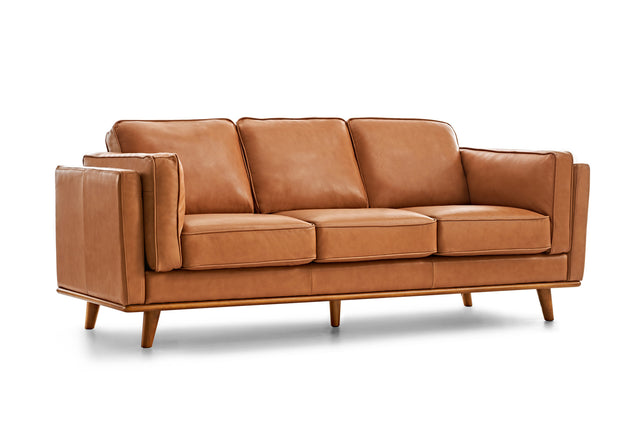
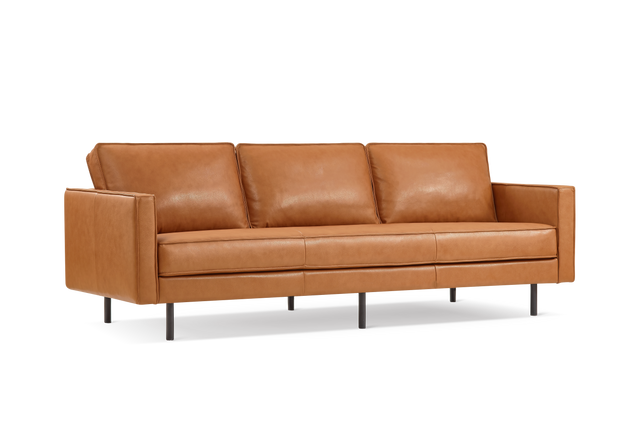
Caramel, cognac, saddle tan, terracotta, and rich chocolate all carry warm undertones — they read as amber, red, or orange beneath the surface tone. These leathers pair naturally with warm walls (cream, butter yellow, warm greige, terracotta) and warm floor species (red oak, cherry, pine, warm walnut). They clash with cool-toned walls (blue-grey, lavender-white, cool taupe) and cool floors (grey tile, weathered grey timber).
Cool leathers
Black, slate grey, pewter, charcoal, and some espresso tones carry cool undertones — blue or green beneath the surface rather than red or orange. These leathers pair well with cool-toned whites, pale greys, blue-influenced greiges, and cool floor finishes like whitewashed oak, grey-stained hardwood, or concrete. They can feel harsh against warm walls if there is no transitional element bridging them.
Neutral leathers
True neutral leathers — certain warm whites, parchment, dove grey, and greige tones — sit close to the warm-cool boundary and tolerate either direction. They are the most flexible option for rooms with mixed temperature elements: a cool grey painted wall alongside blonde oak flooring, for example.
2. Matching with Wall Colours

Walls function as the room's backdrop — they set the baseline tone against which every other element is read. The goal is not perfect matching but intentional relationship: either close tonal harmony, clear contrast, or deliberate complementary tension.
White and off-white walls
The most forgiving backdrop. Pure white walls with cool undertones suit charcoal, black, and grey leathers best. Off-white with warm undertones (cream, ivory, warm white) pair better with caramel, cognac, and tan leathers. Mismatching white's undertone with the leather creates a subtle tension most people sense but cannot name.
Warm neutral walls (greige, taupe, warm stone)
These walls anchor warm leather tones naturally. A caramel leather sofa against a warm greige wall creates a tonal, enveloping feel. To prevent the room from reading as monotone, introduce contrast through a dark accent — a walnut coffee table, black metal lamp, or charcoal area rug. If using a cool leather like charcoal or slate against warm walls, add a warm metallic (brass, copper) to bridge the gap.
Bold and dark walls (navy, charcoal, forest green, terracotta)
Dark or saturated walls require careful leather selection. A cognac leather against a deep navy wall creates the richest combination — the warm-cool contrast is dramatic without being jarring. Charcoal leather against a charcoal wall risks disappearing entirely unless there is strong texture contrast between the two surfaces. Ivory or parchment leather against a dark wall is a high-contrast move that works in traditional or transitional rooms with strong architectural detail.
3. Matching with Floor Finishes

Floors are permanent (or near-permanent) and cover the room's largest surface area after walls. They impose their temperature and tone on everything above them, making them the strongest variable in the pairing equation.
Light-toned floors (blonde oak, ash, maple, light pine)
Light floors are optically generous — they make rooms feel larger and allow almost any leather colour to work. The most elegant pairings are cognac and caramel leathers, which create a warm tonal family with the wood. Black and charcoal leathers create a bold high-contrast statement. Avoid matching the leather too closely to the floor — if both are a similar mid-tone warm blonde, the room loses definition and the sofa disappears.
Dark-toned floors (dark walnut, ebony, dark stained oak)
Dark floors anchor the room at ground level and support heavier, richer leather colours. Chocolate, oxblood, and deep cognac leathers sit beautifully on dark floors — they create a layered tonal depth rather than competing. A pale ivory or parchment leather on a very dark floor creates a striking contrast; this works best in traditional or formal rooms. Avoid mid-tone warm leathers that match the floor too closely — again, definition is lost.
Grey-toned floors (grey-stained wood, concrete, large-format grey tile)
Cool grey floors are the trickiest backdrop for warm leather tones. A cognac or caramel leather on a cool grey floor can look stranded — the undertone mismatch is visible. The solution is either to use a cool-to-neutral leather (charcoal, grey, parchment) that harmonises with the floor, or to introduce a warm-toned area rug that creates a transitional zone beneath the sofa and bridges the undertone gap.
4. The Contrast vs. Harmony Rule
Every successful room lands somewhere on the spectrum between tonal harmony (everything in a similar value range) and deliberate contrast (dark against light). Neither extreme is wrong — they produce completely different atmospheres, and understanding what you are choosing between is more useful than any specific colour rule.
High contrast rooms
A dark leather sofa in a pale room — or vice versa — creates focus and energy. The sofa becomes a clear anchor piece and the room feels well-structured and intentional. High contrast rooms photograph well and read clearly. The risk is that they require the sofa to be in good condition at all times, since it is always the most visually prominent object in the frame.
Tonal harmony rooms
When the sofa, walls, and floor all sit within a close tonal range, the room feels enveloping and restful. A caramel leather sofa against warm greige walls on warm honey oak floors creates a cocoon-like warmth that many people describe as feeling immediately comfortable. The challenge with tonal rooms is maintaining enough textural variation — different surfaces, weights, and finishes — to prevent the room from feeling flat.
Bridging elements
Area rugs, coffee tables, and throw pillows function as bridging elements between the sofa and the room's other surfaces. A warm-toned jute rug under a cool leather sofa on a cool grey floor softens the transition. A dark wood coffee table anchors a light leather sofa that might otherwise float weightlessly in a pale room. Always think of these elements as part of the colour system rather than accessories layered on top of it.
Frequently Asked Questions
What leather colour is the most versatile?
Warm caramel and medium cognac are the two most versatile leather tones. Both sit in the centre of the warm spectrum and tolerate a wide range of wall and floor pairings. They read as neutral in a light room but add richness in a darker one. They also age gracefully — the patina that develops over years on a cognac leather is an asset, not a liability.
Can a black leather sofa work in a warm-toned room?
Yes, with the right bridging elements. Black leather in a warm room can feel stark without something connecting them — a warm-toned jute or wool rug under the sofa, warm brass or copper accents, or a warm timber coffee table all help anchor black leather in an otherwise warm palette. Avoid isolating the sofa; it needs to be woven into the room's material story through the surrounding pieces.
Does leather colour affect how large a room feels?
It does, but less than sofa size does. A large dark leather sofa in a small room feels heavier than a lighter version of the same size — but the size is the bigger variable. If you are concerned about a sofa making a room feel smaller, prioritise a compact or apartment-scale frame over a light colour. A small cognac leather sofa will read better than a large ivory one in a tight space.
Should the leather match the wood tones in the room?
They should share an undertone family rather than match exactly. Wood and leather are both natural materials with inherent tonal variation, so an exact match looks forced and slightly unnatural. The goal is warm leather with warm timber, or cool-neutral leather with grey or whitewashed timber. Contrast between the two is also valid — a light ivory leather sofa on a dark walnut floor is a classic pairing — as long as the undertones are compatible.
How does lighting affect how leather colour looks?
Significantly. Warm incandescent or halogen light amplifies warm leather tones — a caramel leather under warm light looks richer and more saturated. Cool LED or north-facing daylight can grey out warm leather tones and make them look flatter than they are. Before committing to a leather colour, view samples in the actual room at different times of day and under both artificial light and natural light conditions.
Is it a mistake to match the sofa and rug colour closely?
Close tonal matching of sofa and rug can work beautifully in a tonal room — it creates continuity and warmth. The risk is that the sofa loses definition against the rug and the whole composition flattens. The most successful tonal rooms compensate with strong textural contrast: a leather sofa on a coarse jute rug, or a smooth leather on a high-pile wool rug. The textures create separation even when the values are similar.
What wall colour works with every leather sofa colour?
There is no single universal wall colour, but warm off-white (Benjamin Moore White Dove, Farrow & Ball Pointing, Sherwin-Williams Alabaster) comes closest. These warm whites tolerate both warm leathers — where they create harmony — and cool leathers — where they provide a clean, neutral contrast. They are also the most timeless wall choice because they never read as trend-specific.
Can I use a coloured leather sofa — like green or blue?
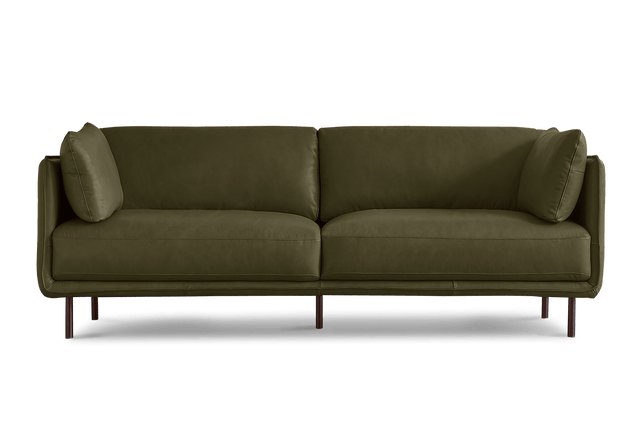
Coloured leather sofas — forest green, deep teal, navy, burgundy — work best in a room with a very restrained palette elsewhere. Keep walls in a near-neutral that shares the sofa's undertone (warm cream with olive green; cool white with teal or navy), and let the sofa carry all the colour. One saturated leather sofa in an otherwise neutral room makes a confident design statement. Two or three saturated elements compete and produce visual noise.


