

In this article: A complete comparison of the three main sofa bed mechanisms — pull-out, click-clack, and fold-down — so you can choose the right one for your space and sleeping needs.
- Pull-Out Sofa Beds (Sleeper Sofas)
- Click-Clack Sofa Beds
- Fold-Down Sofa Beds
- Mattress Quality & Size Options
- Which Type Suits You Best?
- Frequently Asked Questions
Sofa beds are one of the most practical furniture investments you can make — but only if you choose the right mechanism for how you actually use it. Pull-out sleeper sofas, click-clack sofas, and fold-down designs each serve a different kind of user, and picking the wrong one leads to frustration every time you try to convert it. Here is everything you need to know before you buy.

Quick Takeaways
• Pull-out sofas give the most bed-like sleep.
They use a folded mattress on a metal frame and offer the most dedicated sleeping surface, but require more room to open.
• Click-clacks are the simplest to convert.
One motion tilts the back down flat, making them ideal for frequent single-person use in smaller spaces.
• Fold-downs work best for sectionals.
Often integrated into chaise or corner sections, they create a flat lounging surface without requiring the whole unit to convert.
• Mattress thickness matters more than mechanism type.
A 4-inch spring mattress on any mechanism will give a poorer night's sleep than a quality 6-inch or memory foam mattress.
• Measure deployment space before choosing pull-out.
A pull-out queen needs roughly 70–80 inches of clear floor space in front of the sofa when fully extended.
1. Pull-Out Sofa Beds (Sleeper Sofas)

The pull-out sleeper sofa is the classic design: a mattress folds in thirds or halves and sits on a hinged metal frame inside the sofa base. To convert, you remove the seat cushions, pull out the frame, and unfold the mattress. To close it, reverse the process.
Pros of pull-out sofas:
• Largest available sleeping surface — queen and king sizes are possible.
• Most bed-like sleeping experience; guests can use standard bed sheets and pillows in a familiar configuration.
• Available in the widest range of sofa styles — from traditional to contemporary.
• Better for longer stays; the dedicated mattress is more comfortable for multiple consecutive nights than other mechanisms.
Cons of pull-out sofas:
• Conversion is the most involved of the three types — cushions must be removed and stored.
• Require significant floor space when open; a queen pull-out extends approximately 70–80 inches from the sofa's base.
• Heavier and harder to move than click-clack or fold-down designs.
• Bar feel — cheaper models have a center support bar that can be felt through thin mattresses.
2.Click-Clack 
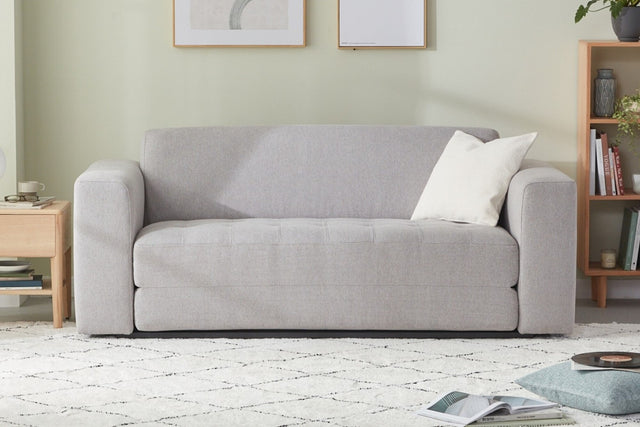
A click-clack sofa converts by pushing the back down to lie flat with the seat, creating a single flat sleeping surface. The name comes from the clicking sound the locking mechanism makes at each angle position — typically three: upright for sitting, reclined for lounging, and fully flat for sleeping.
Pros of click-clack sofas:
• Fastest and simplest conversion — one motion, no disassembly, no extra pieces.
• Compact footprint; the bed extends only as far as the sofa's original depth when flat.
• No cushion removal needed — the upholstery itself becomes the sleeping surface.
• Generally less expensive than pull-out sofas of equivalent fabric quality.
Cons of click-clack sofas:
• Smaller sleeping surface — typically a full or double size at most.
• No separate mattress — you sleep on the seat and back cushions, which is less comfortable for multiple nights.
• Mechanism can loosen over time with heavy frequent use.
• Limited arm height options; many click-clacks have low arms to allow the back to recline fully.
3. Fold-Down Sofa Beds

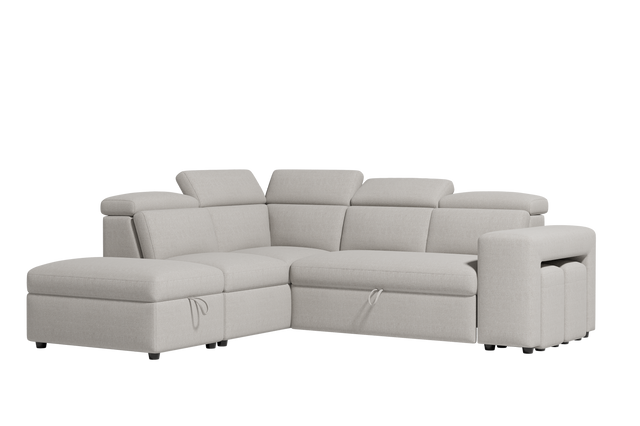
Fold-down mechanisms are most commonly found in sectional sofas with a chaise or corner section. Instead of the entire sofa converting, the chaise or ottoman section has a hinged backrest that folds flat, creating an extended lounging or sleeping surface alongside the main seat area.
Pros of fold-down sofas:
• Seamless integration into sectional designs — the sofa looks entirely standard when not in sleep mode.
• Easy to use; typically operated by pulling a strap or lever on the folding backrest.
• No additional floor space required — the extension stays within the sofa's existing footprint.
• Often paired with storage compartments in the base of the chaise section.
Cons of fold-down sofas:
• Sleeping surface is limited to the chaise or corner portion — narrow for taller sleepers.
• The gap between the main seat cushion and the fold-down section can be uncomfortable unless bridged with a topper.
• Not designed for regular nightly use by guests expecting a bed-like experience.
• Limited to sectional configurations; rarely available as a standalone two-seater.
4. Mattress Quality & Size Options
The mechanism determines how you convert the sofa; the mattress determines how well you sleep on it. Many entry-level sofa beds use thin innerspring or foam mattresses that compress over time and offer minimal support. When choosing a sofa bed intended for regular guest use, prioritize models with mattresses of at least 4.5 inches thickness, and look for memory foam or hybrid options where available.
Common mattress types in sofa beds:
• Innerspring: coil-based, traditional feel, good air circulation, but can transmit bar feel on pull-outs.
• Foam: supportive and quiet, easier to fold into the sofa frame, available in varying density levels.
• Memory foam: conforms to body shape, best comfort for overnight use, heavier and harder to fold.
• Hybrid: combines coil support with foam comfort layers — the best balance of support and foldability for pull-out designs.
Standard sofa bed sleeping sizes:
• Twin: 38 x 75 inches — suitable for one adult, common in smaller click-clacks.
• Full/Double: 54 x 75 inches — fits two adults comfortably for short stays.
• Queen: 60 x 80 inches — the most popular pull-out size, equivalent to a standard guest room bed.
• King: 76 x 80 inches — available in some larger pull-out sectionals, requires significant deployment space.
5. Which Type Suits You Best?
The right mechanism depends on how often the sofa will be used as a bed, who will sleep on it, and how much space you have available.
Choose a pull-out sleeper sofa if: guests stay for multiple nights regularly, you want a queen or king sleeping surface, or sleep quality is the primary priority alongside sofa comfort.
Choose a click-clack if: the sofa will occasionally convert for a single overnight guest, space is limited, or you want a simple mechanism with minimal effort.
Choose a fold-down if: you already want a sectional design and want an occasional lounging or sleeping option integrated into the chaise section without extra bulk.
Frequently Asked Questions
What is the most comfortable sofa bed type for overnight guests?
For overnight and multi-night guest comfort, a pull-out sleeper sofa with a quality foam or hybrid mattress offers the most bed-like experience. The separate mattress (rather than the sofa cushions) provides dedicated sleeping support and allows you to use standard fitted sheets.
How much space does a pull-out sofa bed need when open?
A pull-out queen sofa bed extends approximately 70–80 inches from the front of the sofa base when fully deployed. Add the sofa's own depth (typically 34–38 inches) and you need a clear floor run of around 9 feet from the wall to any obstruction in front of the sofa.
Can a sofa bed be used as a regular bed every night?
It is possible but not ideal for most standard sofa beds. The mechanisms and mattresses are designed for occasional use. If you plan to sleep on it every night, look specifically for models rated for daily use with a thicker, denser mattress — and budget accordingly, as daily-use sofa beds cost significantly more than occasional-use models.
What is the difference between a sofa bed and a sleeper sofa?
The terms are used interchangeably in North America. In British English, a sofa bed often refers to any sofa that converts for sleeping (including click-clacks), while a sleeper sofa more specifically implies the pull-out metal frame and folded mattress design. In practice, both terms describe the same product range.
Is a click-clack sofa comfortable to sleep on?
For an occasional single overnight stay, a click-clack with good foam density is reasonably comfortable. For anything longer or for a heavier guest, the lack of a dedicated mattress becomes apparent. Adding a mattress topper significantly improves the sleep experience on click-clack models.
Do sofa beds come in queen size?
Yes. Queen-size pull-out sofa beds (60 x 80 inches when open) are among the most common configurations and are available from most major furniture brands. King-size pull-outs exist but are less common and require a very wide sofa frame — typically found only in larger sectional designs.
How do I choose between a sofa bed and a dedicated guest bed?
A sofa bed makes sense when the room serves dual purposes — living and sleeping — and a dedicated bed would waste space most of the time. A dedicated guest bed is the better choice when you have a permanent guest room, host guests frequently for multi-night stays, or if sleep quality for guests is a priority over space efficiency.