

In this article: A clear breakdown of what separates a dedicated home theater from a media room — and a decision framework to help you choose the right approach for your space, budget, and household.
- What Defines a Home Theater
- What Defines a Media Room
- Key Differences at a Glance
- Which Should You Build?
- The Hybrid Approach
- Frequently Asked Questions
A home theater is a dedicated, light-controlled room built around a single purpose: the best possible audio and video experience. A media room is a flexible, multipurpose space that balances entertainment with other household functions. The right choice depends on how the room will actually be used — not on which sounds more impressive.

Most households that think they want a home theater actually want a very good media room. A few truly want — and can support — a dedicated cinema space. This guide lays out the defining characteristics of each, the practical tradeoffs, and when a hybrid approach makes sense. For a full room setup walkthrough see the Home Theater Room Setup Guide.
Quick Takeaways
• A dedicated home theater is defined by light control and acoustic treatment first.
The projector, screen, and seats are secondary — a room without blackout capability and acoustic panels is not a theater regardless of the equipment inside it.
• A media room trades performance for flexibility.
Ambient light, flexible seating, and a large TV serve more household members more of the time — at the cost of peak cinematic performance.
• Cost is not the primary differentiator.
A media room can cost more than a dedicated theater. The difference is room architecture and usage intent — not the dollar value of the equipment.
• Most households end up happier with a well-built media room.
A room that requires everyone to observe strict blackout conditions and assigned seating gets used less — not more.
• A hybrid design is possible but requires higher upfront investment.
Motorized blackout shades, a high-lumen projector, and seating that works for multiple configurations cost more than committing to one approach from the start.
1. What Defines a Home Theater

A home theater is an architectural commitment, not just an equipment purchase. The room itself is designed around a single viewing experience — nothing in the space serves a competing function when the theater is in use.
Defining characteristics of a dedicated home theater:
• Complete light control: Every source of ambient light is eliminated or blockable — no windows, or full blackout shades that seal completely. The projector is the room's only light source during viewing.
• Projector and fixed screen: A front-projection setup with a 100–135-in fixed-frame screen. The screen is permanently mounted; the projector is ceiling-mounted at a calibrated position.
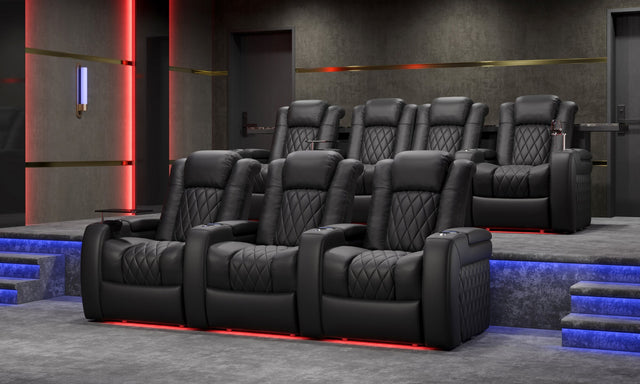
• Dedicated theater seating: Fixed rows of theater chairs oriented toward the screen. Seating is not rearranged for other activities. Row spacing and riser height are engineered for the specific screen and room depth.
• Acoustic treatment: Absorption panels at first reflection points, bass traps in room corners, and diffusion on the rear wall. The room is tuned to minimize reflections and standing waves, not decorated.
• Surround sound system: A full 5.1, 7.1, or Atmos speaker layout with in-wall or in-ceiling speakers. Speaker placement follows acoustic guidelines — not aesthetic placement decisions.
A home theater requires a room that can be permanently dedicated to this use. Basements are the most common candidate — they typically have no natural light, minimal noise intrusion from adjacent spaces, and structural characteristics that support acoustic treatment. Converting a room above grade is possible but requires more investment to achieve equivalent performance.
2. What Defines a Media Room

A media room is an entertainment-focused space that handles multiple activities — movie nights, sports viewing, gaming, family TV time — without requiring the room to be permanently configured for a single use. It prioritizes usability across more situations over peak cinematic performance in one.
Defining characteristics of a media room:
• Ambient light tolerance: A large-format TV (75–100 in) rather than a projector. TVs perform equally well in lit and dark rooms; projectors do not. Windows and overhead lighting do not require management.
• Flexible seating: Theater chairs, sectional sofas, or a combination that allows different household members to use the room for different activities without restructuring the space.
• Multiple use cases: The room comfortably hosts a mix of gaming, sports, casual viewing, and conversation — not just movie watching.
• No dedicated acoustic treatment required: Media rooms benefit from acoustic treatment but do not require it. Room treatments are optional enhancements, not architectural prerequisites.
• Sound system flexibility: A soundbar with a subwoofer, or a modest 5.1 system with bookshelf speakers, delivers excellent results in a media room without the speaker placement precision required in a dedicated theater.
Media rooms are more accessible for most households because they do not require a dedicated space that cannot serve another function. A family room, a bonus room above a garage, or even a large bedroom can become a very functional media room without major architectural modifications.
3. Key Differences at a Glance

| Factor | Home Theater | Media Room |
|---|---|---|
| Display type | Projector + fixed screen (100–135 in) | Large-format TV (75–100 in) |
| Light control | Complete blackout required | Ambient light acceptable |
| Seating | Fixed rows, engineered row spacing | Flexible; sofas, chairs, or mixed |
| Acoustics | Treatment panels required | Optional enhancement |
| Room dedication | Single purpose | Multipurpose |
| Room requirement | Dedicated space (typically basement) | Any room with adequate square footage |
| Peak performance | Cinema-equivalent image and sound | High-end consumer entertainment |
| Household usability | High for viewers; restricted for others | High across all household members |
The cost comparison is less clear-cut than most people expect. A well-equipped media room with a 100-in TV, a strong sound system, and premium seating can easily cost more than a dedicated theater with a mid-range projector and basic acoustic treatment. The difference is not cost — it is commitment to a single use case versus maintaining flexibility.
4. Which Should You Build?

The answer comes down to three questions about your household's actual viewing habits and space availability.
Build a dedicated home theater if:
• You have a room that can be permanently dedicated — not a family room that doubles as a guest bedroom or a space used for other activities during the day.
• The primary viewing group is consistent — household members who will watch together regularly from fixed positions, rather than a rotating group of family members with different preferences.
• Cinema experience is the goal — you want the projector, the large screen, the acoustic treatment, and the dedicated chairs because the experience difference matters to you enough to give up multipurpose flexibility.
• The room can achieve full light control — a basement or interior room with no windows, or a room where blackout shades can be installed on every opening. Without light control, a dedicated theater delivers less performance than a media room with a good TV.
Build a media room if:
• The space is used for multiple activities — gaming, sports, family TV time, casual viewing, and occasionally a movie night that requires serious performance.
• Different household members use the room differently — children doing homework at one end, adults watching TV at the other. Fixed theater rows and assigned seating frustrate mixed-use households.
• The room has windows or natural light — converting a room with windows to a functional theater requires substantial investment in blackout shades and light-gap sealing. For most above-grade rooms, a large TV is the more practical display choice.
• Budget or timeline is constrained — a media room can be built incrementally. Start with a good TV and a soundbar; add seating and a better sound system over time. A home theater build requires most of the investment upfront before the room can be used.
5. The Hybrid Approach

A hybrid room tries to deliver dedicated theater performance while retaining media room flexibility. Done well, it is the best of both approaches. Done poorly, it achieves neither — the room is too compromised for peak theater performance and too fixed to serve as a genuine multipurpose space.
What a successful hybrid requires:
• Motorized blackout shades on all windows: The ability to go from fully lit to complete darkness at the press of a button is what makes a hybrid room viable. Manual shades that require closing and securing each time do not get used consistently, and the theater experience degrades every time they are skipped.
• High-lumen laser projector or ALR screen: A hybrid room typically has more residual ambient light than a dedicated basement theater. A laser projector rated at 2,500–4,000 ANSI lumens, or a projector screen with ambient light rejection (ALR) technology, compensates for this during bright-conditions use.
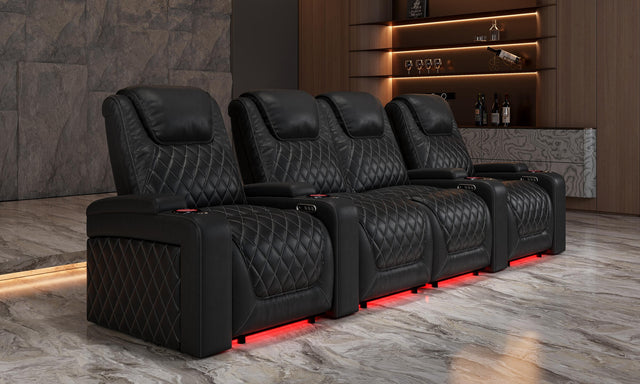
• Seating that works in multiple configurations: A row of three theater seats can function as a sofa replacement in a living room layout — but a fixed two-row installation with a riser cannot. Hybrid rooms typically use a single flexible row rather than a fixed multi-row setup.
• Lighting zones that support both use cases: Separate dimmer zones for background lighting, ambient lighting, and bias lighting allow the room to transition between configurations without requiring every light to be extinguished or every scene to be manually reset.
When a hybrid makes financial sense: When the household has a single room that must serve both purposes and building a second dedicated theater space is not practical. A hybrid room at $25,000–$40,000 often provides more value than a media room and a dedicated theater built separately at $15,000 and $20,000 respectively — because it concentrates investment in a single well-finished space rather than two partially equipped rooms.
For households that want the hybrid approach but are uncertain how to configure seating, the How to Choose Home Theater Seats guide covers seat selection for both theater and multi-use contexts.
Frequently Asked Questions
Can a media room have a projector?
Yes, but with tradeoffs. A projector in a media room requires either an ALR screen, a high-lumen laser projector (2,500+ ANSI lumens), or motorized blackout shades to manage ambient light. Without these, a projector produces a washed-out image whenever the room has natural light. For rooms that regularly operate in ambient light conditions, a large-format TV delivers better results at lower cost.
Is a home theater worth the investment?
For households that watch films regularly in a group, a dedicated theater pays dividends in experience quality that is genuinely difficult to replicate with any consumer setup outside a purpose-built room. For households that watch casually — mostly TV series, sports, and occasional movies — a well-equipped media room delivers more value because it gets used more often. The investment is worth it when the room matches actual usage patterns, not aspirational ones. See the Home Theater Budget Guide for a full cost analysis.
What seating works in both a theater and a media room?
A row of two to three power recliners with a center console works well in both contexts. In a theater, the row is oriented to the screen at the correct viewing distance. In a media room, the same seats function as a premium sofa replacement. The home theater seating collection includes configurations from single seats to rows of five — choose configurations that match both your theater layout and your room's non-theater functions.
Do media rooms need acoustic treatment?
Not as a prerequisite, but treatment improves the experience noticeably. Even basic first-reflection panels on side walls and a rug on hard flooring will make dialogue cleaner and reduce the sense of sound bouncing around the room. In a media room, acoustic panels can double as wall décor when fabric-wrapped in materials that match the room's aesthetic. A small amount of treatment goes a long way in a room that was not designed around acoustics.
Can I convert a media room into a dedicated theater later?
Yes, but it is more expensive than planning for it from the start. Converting a media room to a theater requires adding light control (motorized shades or window elimination), acoustic treatment, a projector and screen to replace the TV, a ceiling mount, and potentially AV wiring that was not pre-run. Pre-wiring for a future projector during the media room build — even if you do not install it immediately — costs almost nothing extra and saves significant rework later.
How much space do I need for a media room?
A functional media room can work in a 12 × 14 ft space with a 75–85-in TV and a sofa or two-seat theater chair row. Comfortable media room setups typically run 14 × 18 ft or larger, allowing multiple seating zones and a larger display. Unlike a dedicated theater, there is no strict minimum — a media room scales with the space available rather than requiring specific architectural minimums. For room-specific layout guidance see Home Theater Layout Ideas for Every Room Size.
Does a home theater add value to a home?
A well-finished dedicated theater room typically returns 65–85% of its build cost at resale according to most appraisal guidance — similar to other specialty rooms like wine cellars and indoor gyms. A media room returns more reliably because it appeals to a wider range of buyers. Overly specialized built-ins (non-standard projection systems, custom equipment racks) can reduce rather than increase buyer appeal if they are difficult to repurpose. The safest investment is a quality-finished room with versatile infrastructure rather than permanently installed equipment.
What is the best seating for a media room?
For media rooms, prioritize seats that work well across multiple activities — not just movie watching. A two- or three-seat power recliner configuration with a center console provides theater-quality comfort for movies while functioning as a living room sofa for casual TV viewing and gaming. The Home Theater Seating Features guide covers which features — power recline, heating, massage, USB charging — are actually worth the upgrade in a media room context versus a dedicated theater.