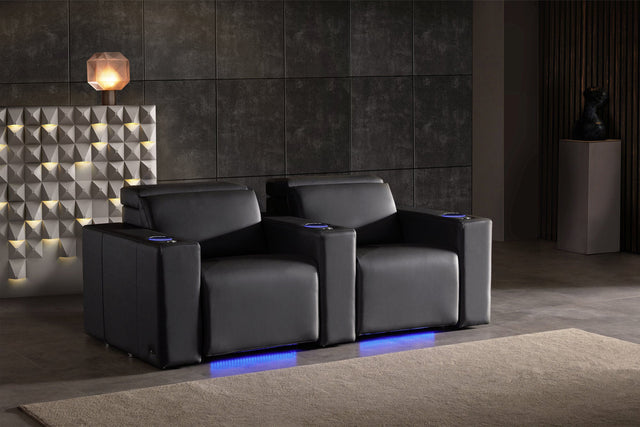

In this article: Six honest questions that cut through marketing noise and help you choose the right home theater seats for your room, your household, and your actual budget.
- What Is the Room Actually For?
- How Many People Watch, Most Nights?
- What Does Your Room Actually Measure?
- What Material Grade Makes Sense?
- Which Features Will You Actually Use?
- What Is Your Real Budget Per Seat?
- Frequently Asked Questions
Choosing home theater seats comes down to six honest questions and if you answer them before you start browsing product pages, you'll avoid the most common and costly mistakes: too many seats for the room, the wrong material for your lifestyle, or skipping features you'll use every single session.

This guide covers each decision point directly, with specific benchmarks and links to deeper resources for whichever details matter most to your setup.
Quick Takeaways
• A dedicated room calls for dedicated theater chairs.
Mixed-use rooms are better served by a premium reclining sectional that blends naturally into the space.
• Match seat count to real usage.
Design for a typical Tuesday night, not a once-a-year party.
• Measure row depth first.
Running out of recline clearance is the most preventable mistake in home theater planning.
• Leather grade matters over time.
For 10+ year ownership, moving up a tier is almost always worth it.
• Don't skip power headrest + USB.
These are used every session and are hard to retrofit later.
1. What Is the Room Actually For?

A dedicated cinema space calls for dedicated theater chairs. A multipurpose room might be better served by a premium reclining sectional that doesn't announce itself as a home theater the moment you walk in. If you're unsure: would you remove the seating if you stopped using this room for movies? If yes, buy theater chairs.
The distinction matters because theater chairs are engineered specifically for a cinema use case:
• Fixed-row layout — designed with sight lines, row spacing, and consistent screen distance in mind
• Cinema aesthetic — cupholder consoles, LED mood lighting, and coordinated upholstery that reads as an intentional design decision
• Deep recline — most theater seats fully recline without requiring excessive floor clearance, especially wall-hugger models
• Modular configurations — available in row-of-2 through row-of-5, making it simple to plan around exact room dimensions
If your room doubles as a guest room, a home office, or an everyday TV lounge, a reclining sofa or sectional blends in more naturally — and still delivers genuine comfort for viewing. See our full comparison: Theater Seating vs. Recliners: Which Is Right for Your Room?
| Room type | Best seating match | Why |
|---|---|---|
| Dedicated home theater | Theater chairs (rows) | Optimized for fixed sight lines, deep recline, and a cinematic atmosphere |
| Finished basement / media room | Theater chairs or reclining sectional | Either works well — depends on how formal you want the space to feel |
| Living room / multipurpose space | Reclining sofa or sectional | Blends naturally — doesn't visually redefine the room as a cinema |
2. How Many People Watch, Most Nights?

Not during the Super Bowl. On a typical Tuesday evening. The seat count should match realistic household usage — buying 6 seats for a household that usually watches in groups of 2 means 4 chairs permanently eating up floor space and budget.
• 1–2 viewers: A loveseat (row-of-2) is the cleanest option. Compact footprint, no empty seats, easy to plan around.
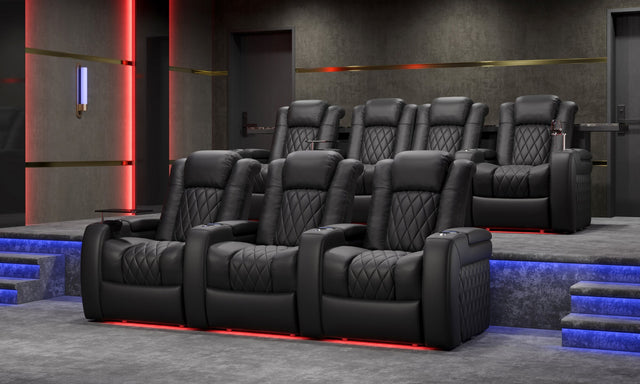
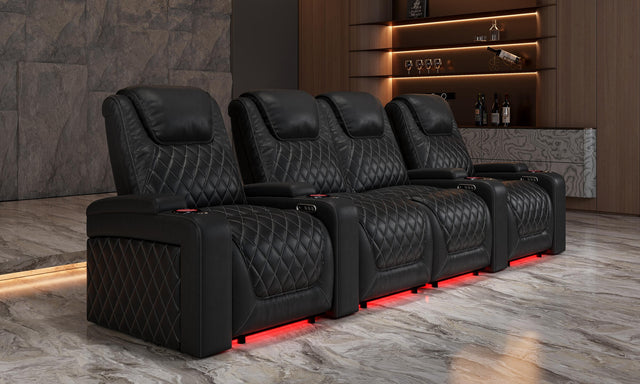
• 3–4 viewers: Row-of-3 or row-of-4 — the most common home theater setup. A single row keeps everyone at the same viewing distance and avoids the complexity of adding a riser.
• 5+ viewers: Row-of-5 or two rows. With two rows, a riser is strongly recommended so back-row viewers have unobstructed sight lines over first-row heads.
One practical approach for households that host frequently but don't have the floor space for a second row: consider a row-of-3 with a separate loveseat positioned at a slight angle to the side. This gives you flexible seating capacity without committing to a full riser build.
Not sure how many seats your room can physically accommodate? Read: How Many Seats Do You Need for Your Home Theater?
3. What Does Your Room Actually Measure?

Get a tape measure before browsing. The dimensions that matter most are often not what first-time buyers expect — it's rarely total square footage, and almost always about row depth and wall clearance.
Most Valencia theater seats are 22–24 inches wide per seat position — a row-of-3 typically spans 72–80 inches total. Use the table below as your planning baseline:
| Measurement | Minimum | Recommended | Notes |
|---|---|---|---|
| Seat width per position | 22 in | 24 in | Row-of-3 = approx. 72–80 in total |
| Row depth (front edge to back wall / next row) | 36 in | 42 in | 36 in works; 42 in is noticeably more comfortable |
| Wall clearance — standard recline | 12–18 in | 18+ in | Backrest-to-wall; varies by model |
| Wall clearance — wall hugger | 4–6 in | 6 in | Wall huggers slide forward as they recline — no backward clearance needed |
| Row-to-row spacing (two rows) | 48 in | 54–60 in | With a riser: 48 in works. Without: 60 in minimum for clear sight lines |
Quick planning tip: Before ordering, tape the seat footprint on your actual floor. Walk around it. Sit in a chair and extend your arms where armrests would be. Seeing it in the actual space is worth the 10 minutes.
For a full room planning walkthrough with layout examples: Home Theater Seating Layout & Row Spacing Guide
4. What Material Grade Makes Sense?

Valencia seating is available across leather tiers that genuinely feel different — not just a marketing label, but a real difference in softness, aging, and long-term maintenance.
| Tier | Material | Feel & character | Best for |
|---|---|---|---|
| Cinema Series | Top-grain leather | Clean, structured, wipes down easily — holds up well in active households | Families, higher-traffic rooms, shorter ownership horizon (5–8 years) |
| Premier / Luxury | Premium top-grain leather | Noticeably softer and more supple from day one; better aging profile | Long-term ownership — the most popular balance of quality and value |
| Bespoke Nappa 20K | Italian Nappa leather | Distinctly soft; develops a warm, rich patina over years of use | Flagship investment — rooms you plan to keep for 10–15+ years |
Cinema-series leather is excellent. Bespoke Nappa 20K feels softer immediately and ages more gracefully over a decade — the difference is real but most noticeable as years pass. If this is a long-term room, moving up a tier is usually the right call when budget allows.
Want to understand the leather grades in more depth? What Is Italian Nappa Leather? (And Why It Matters for Furniture)
5. Which Features Will You Actually Use?

Theater seating comes with a long feature checklist. Most of it is genuinely useful — but some features get used every session while others are nice-to-have. Here's an honest breakdown:
| Feature | Worth it? | Why |
|---|---|---|
| Power headrest | Yes — for almost all setups | When you recline, your body angle shifts but the screen stays put. A power headrest tilts your head forward so your eyes stay on screen without neck strain. You'll use it every session. |
| Power lumbar | Yes — especially for 90+ min sessions | Adjustable lumbar removes lower-back fatigue on long viewings. Particularly valuable when multiple people with different body shapes share the same seat. |
| Power recline | Yes — almost always | Infinitely adjustable positions — shallow recline for casual viewing, full recline for long films. The difference from manual recline is immediately noticeable. |
| Heat | Situational | Genuinely relaxing in cool basement theaters. Less essential in warmer rooms or if you tend to run warm. |
| Massage | Nice-to-have | More of a wellness feature than a viewing upgrade. Worth it if that's specifically what you want — not a priority over better leather or headrest. |
| Wall hugger | Critical if seats are <18 in from wall | Standard recliners push backward as they open. Wall huggers slide the seat forward instead — giving you full recline position without contacting the wall. |
| USB charging | Yes — very high daily utility | Keeps phones charged without leaving the room. Easy to undervalue until you don't have it. |
| LED lighting | Nice — especially with multiple rows | Helps guests navigate safely in a dark room. Adds to the cinematic atmosphere without overhead lights. Rarely regretted. |
For a deeper dive on each feature and who benefits most: Home Theater Seating Features That Actually Matter
6. What Is Your Real Budget Per Seat?

The most important thing to know: pricing is almost always listed per row, not per seat. A "row-of-2" is two connected seats — divide by two to get the true per-seat cost. This is where a lot of buyers get confused when comparing brands side by side.
Current pricing tiers across Valencia's home theater seating lineup:
| Series | Starting price (row-of-2) | Leather tier | Standout features |
|---|---|---|---|
| New Syracuse (Cinema Series) | From $861 | Top-grain leather | Power recline, USB charging, LED lighting |
| Piacenza Power Headrest | From $921 | Top-grain leather | Power headrest + power recline |
| New Tuscany (Premier) | From $1,086 | Premium top-grain | Power headrest + lumbar, USB, wall hugger |
| Oslo Luxury | From $1,386 | Premium top-grain | Power headrest, zero-gravity recline, full feature set |
| Tuscany Ultimate (Bespoke Nappa) | From $1,889 | Italian Nappa 20K leather | Full feature set, Nappa leather, multiple color options |
The question worth asking honestly: what is the right per-seat investment for how long I plan to own this? A $1,800 seat held for 12 years costs less per year than a $900 seat replaced after 5 — and the daily experience is meaningfully better throughout.
Browse the full lineup with current configurations and pricing: Home Theater Seating Collection →