

In this article: A practical framework for deciding between 2, 3, 4, or more seats — based on who actually uses the room, room width constraints, and when a two-row setup makes sense.
- Start With Who Actually Watches
- Room Width Constraints by Row Size
- The Features vs. Seat Count Trade-off
- When to Consider a Two-Row Setup
- Seat Count by Use Case
- Frequently Asked Questions
Most people overbuy seats — they picture a full row for the big game, then spend 95% of their actual use with two people in the room. The right seat count is the one that fits how you use the space on a typical Tuesday evening, not how you imagine using it for a once-a-year gathering.

This guide walks through the seat count decision in the order it actually matters — starting with who watches, working through room constraints, and ending with specific seat counts for common household setups. For the width and depth measurements behind each configuration, see the Layout & Row Spacing Guide.
Quick Takeaways
• Design for your regular viewing group, not your maximum capacity.
If two people watch 90% of the time, a row-of-3 is already generous. A row-of-5 built for occasional gatherings means three empty seats every other night.
• Features beat seat count on a fixed budget.
A row-of-2 with full features is a dramatically better experience than a row-of-4 with none. The people sitting in those chairs every night feel the difference.
• Room width often decides the seat count before you do.
Measure your usable wall-to-wall width before choosing a configuration — many rooms physically can't fit a row-of-4 with proper side clearance.
• A two-row setup requires a riser and significantly more depth.
Two rows work well in rooms with 18+ feet of depth. In shallower rooms, a well-chosen single row is a better outcome.
• Rows longer than 4 seats create unwanted end positions.
Seats more than 35 degrees off screen center produce visible image distortion — very wide single rows may push end seats past this threshold.
1. Start With Who Actually Watches

The most useful question isn't "how many seats could I fill" — it's "how many seats are occupied on a typical viewing night." Be honest about this. Most home theater rooms serve 2–3 regular viewers, with larger groups showing up a few times per year.
Household viewing patterns and seat count
| Regular viewers | Recommended config | Notes |
|---|---|---|
| 1–2 people | Row-of-2 | Maximize feature quality; a loveseat with console is the premium option |
| 3 people | Row-of-3 | The most common Valencia configuration; fits most rooms cleanly |
| 4 people | Row-of-4 | Requires 12–13 ft of usable room width; verify before ordering |
| 5+ people regularly | Two-row setup | Row-of-3 front + row-of-3 back = 6 seats; requires riser and 18+ ft depth |
If your regular group is 3 people but you occasionally host 6, the right answer is usually a row-of-3 with excellent features — not a row-of-5 where 3 seats are always empty. Folding chairs handle rare overflow better than a permanent wide row does daily use.
2. Room Width Constraints by Row Size

Room width constrains seat count more directly than almost any other factor. Before choosing a configuration, measure your usable wall-to-wall width and subtract 12 inches per side for minimum clearance. The remaining space is your maximum row width.
| Row config | Row width | Min room width | Comfortable room width |
|---|---|---|---|
| Row-of-2 | ~73–78 in | ~85–90 in (7 ft) | 9+ ft |
| Row-of-3 | ~108–116 in | ~120–128 in (10 ft) | 12+ ft |
| Row-of-4 | ~144–154 in | ~156–166 in (13 ft) | 14+ ft |
| Row-of-5 | ~178–190 in | ~190–202 in (16 ft) | 17+ ft |
These are approximate widths — verify exact dimensions against the specific Valencia model you're considering before ordering. Different series have slightly different seat widths.
3. The Features vs. Seat Count Trade-off

When budget is the constraint, adding seats and adding features pull in opposite directions. The people who regret not having power headrest or heat on their seats are far more common than the people who regret having a row-of-3 instead of a row-of-4.
The practical test
Compare two scenarios for your budget:
• Option A — More seats: A row-of-4 without power headrest, lumbar, or heat.
• Option B — Better seats: A row-of-3 (or row-of-2) with the full feature set.
The people in Option B will be noticeably more comfortable through a three-hour film. The empty fourth seat in Option A doesn't add anything to their experience. Unless that fourth seat is reliably occupied, Option B wins on quality of use.
For a full breakdown of which features matter most and how to prioritize them, see Home Theater Seating Features That Actually Matter.
4. When to Consider a Two-Row Setup

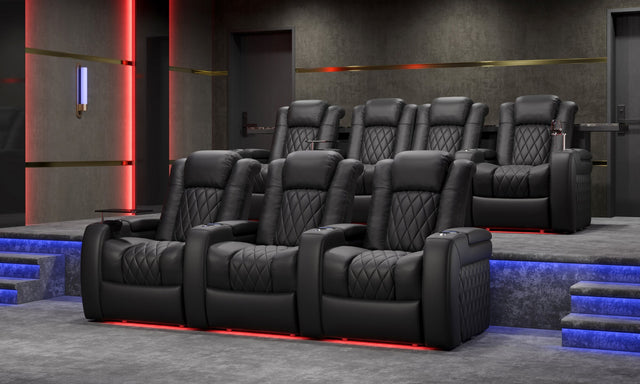
Two rows make sense when your regular viewing group is large enough that a single row can't accommodate them, or when you want the cinema experience of elevated seating. They require significantly more planning and room depth than a single-row build.
What a two-row setup requires
• Room depth: Minimum 18 feet from screen to back wall for a two-row build with 42 inches of row spacing and a 12–14 inch riser. 20+ feet is comfortable.
• Ceiling height: Standard 8-foot ceilings are workable but tight. 9 feet is significantly more comfortable for riser builds.
• Riser construction: A properly framed platform adds cost and timeline to the build. Plan for it upfront, not as an afterthought.
• Row sizing: The two rows don't need to match. A smaller front row and a wider back row (putting more seats in the prime elevated position) is a common and functional layout.
The full riser planning guide is at Do You Need a Theater Riser for Home Theater Seating?
5. Seat Count by Use Case

| Use case | Recommended seats | Priority |
|---|---|---|
| Couple, daily use | Row-of-2 | Maximize features; consider console configuration |
| Family of three | Row-of-3 | Most popular configuration; fits most rooms |
| Family of four | Row-of-4 or row-of-3 + extra | Verify room width before committing to row-of-4 |
| Regular groups of 5–6 | Two-row setup (3+3 or 3+4) | Requires 18+ ft of room depth and a riser |
| Occasional large groups | Row-of-3, add folding chairs for events | Don't size for the exception; optimize for daily use |
For a broader look at the full home theater planning process, see the Complete Guide to Home Theater Seating.
Frequently Asked Questions
Can I add more seats to my Valencia row later?
Valencia theater seats are sold in row configurations, not as individual modular seats. Going from a row-of-2 to a row-of-3 means replacing the full row. Plan for the seat count you want long-term — it's easier and less expensive than replacing a row that no longer fits your needs.
Should I prioritize features or seat count on a fixed budget?
Features. A row-of-2 with power headrest, lumbar, and heat is a dramatically better daily experience than a row-of-4 without them. The people who sat in those chairs every night for three years overwhelmingly prefer having had the better features. See Home Theater Seating Features That Actually Matter for what to prioritize.
Can I put different row sizes on a riser vs. the floor?
Yes. There's no requirement that rows match in size. A smaller front row and a larger back row (putting more seats in the elevated prime position) is common and functional. Center both rows on the screen for symmetrical sightlines.
Is it okay to have empty seats in a home theater?
Completely normal. A row-of-3 with two people in it just means comfortable elbow room — nobody is cramped. Empty seats in a home theater are not wasted space the way they would be in a commercial venue. Size for your regular group and the empty seat is a benefit, not a problem.
What's the most popular seat count for a home theater?
Row-of-3 is the most common single-row configuration. It fits most rooms, serves families of 2–3 comfortably (with room to spread out), and provides enough width to feel like a proper theater row without requiring a very wide room. For two-row builds, 3+3 (six seats total) is the most common configuration.
How do I decide between a row-of-4 and a two-row setup?
A row-of-4 in a single row is simpler to build, requires less room depth, and avoids riser construction. A two-row setup (e.g., 2+3 or 3+3) provides a better viewing experience for all viewers by placing the back row at an elevated angle. Choose single-row if depth is tight; choose two-row if you have 18+ feet of room depth and want the cinema feel. See the Layout & Row Spacing Guide for full dimensions.