

In this article: Exact measurements for home theater seating layouts — row depth, seat width, screen distance, sightline angles, riser requirements, and real room size examples from 10×12 to 14×20 ft.
- The Two Measurements That Determine Everything
- Seat-to-Screen Distance
- Row Spacing and Recline Clearance
- Layout by Room Size
- Riser Planning for Two-Row Setups
- The 35-Degree Sightline Rule
- Frequently Asked Questions
Measure first, then browse — most layout mistakes (a row too wide, too close to the wall, sightlines blocked by the front row) are entirely preventable with a tape measure and the numbers in this guide. Getting the layout right is not complicated, but it does require working through the measurements in the right order before you commit to a seat configuration.

This guide covers the key dimensions in the order you need them — starting with the two numbers that constrain everything else, working through screen placement and row spacing, and finishing with specific layouts for common room sizes. For the riser planning that two-row setups require, see section 5.
Quick Takeaways
• Row depth is the most commonly underestimated dimension.
42 inches per row (front to back) is the comfortable minimum for reclining seats. Going tighter creates a room where seated viewers can't get past each other.
• Screen distance is a range, not a fixed number.
Multiply your screen diagonal by 1.5 to 2.0 (in inches) to get the optimal range. Both ends of the range are comfortable — the closer end is more immersive, the farther end is more relaxed.
• A second row almost always needs a riser.
Headrests on full-size theater recliners reach 48–54 inches — enough to block the screen for anyone seated directly behind them at floor level.
• Row width is easier to get wrong than you'd expect.
Measure available wall-to-wall width, subtract 12 inches per side for clearance, then check whether your target row fits in the remainder.
• End-seat viewing angles matter more in wider rows.
Keep end seats within 35 degrees of screen center for comfortable viewing. Row-of-5 in a narrow room can push end seats beyond this threshold.
1. The Two Measurements That Determine Everything

Row depth (front-to-back dimension per row)
This is the most commonly underestimated measurement. Each row of reclining theater seating requires a minimum of 36 inches front-to-back — measured from the wall (or the back of the riser front edge) to where the next row begins. 42 inches is the comfortable standard that allows a viewer to walk in front of a fully-reclined occupant without contact.
• 36 inches: Minimum. Seated viewers in the row behind must slide past — workable but tight.
• 42 inches: Comfortable standard. Someone can pass in front of a fully reclined seat without squeezing.
• 48+ inches: Generous. Common in dedicated rooms where the builder wants aisle space comparable to a commercial cinema.
Available seat width (left-to-right dimension per row)
Most Valencia theater seats are 22–24 inches per seat position. Use these approximate row widths as a starting point, then verify against the specific model's published dimensions:
| Configuration | Approx. width | Minimum room width needed |
|---|---|---|
| Row-of-2 | 48–54 in | ~72–78 in (6–6.5 ft) |
| Row-of-3 | 72–80 in | ~96–104 in (8–8.7 ft) |
| Row-of-4 | 96–104 in | ~120–128 in (10–10.7 ft) |
| Row-of-5 | 120–128 in | ~144–152 in (12–12.7 ft) |
Add 6 inches minimum (12 inches preferred) on each side between the armrest and the wall. Verify exact dimensions against the model spec before ordering.
2. Seat-to-Screen Distance

The standard formula for home theater viewing distance is screen diagonal × 1.5 to 2.0, with screen diagonal measured in inches and the result in inches (convert to feet by dividing by 12).
| Screen size | Optimal range | Notes |
|---|---|---|
| 100-inch diagonal | 12.5–16.5 ft | Works in most 14-foot or deeper rooms |
| 120-inch diagonal | 15–20 ft | The most common projector screen size for dedicated theaters |
| 150-inch diagonal | 18.75–25 ft | Requires a longer room; typically 20+ ft from screen to back wall |
This formula is based on SMPTE and THX reference standards. The closer end of the range (1.5×) produces a more immersive experience with more peripheral screen fill. The farther end (2.0×) is more relaxed and forgiving if viewers shift position frequently. Both are comfortable — choose based on how you want the room to feel.
Note that the distance is measured from the screen surface to the viewer's eye position, not to the front of the seat or the back wall.
3. Row Spacing and Recline Clearance

Row spacing is measured front-to-front (the front edge of one row's seat base to the front edge of the next row's seat base). This is different from the depth clearance needed behind a row for the reclined footrest.
Recline clearance behind the seat
When a theater seat fully reclines, the footrest extends 18–26 inches forward from the front of the seat base. Add the seat base depth itself (typically 20–24 inches), and a fully-reclined seat occupies 38–50 inches of front-to-back floor space.
• Wall-hugger models: The seat slides forward during recline, moving toward the screen rather than into the wall. Required wall clearance drops from 18–24 inches to 4–6 inches.
• Standard mechanism: The backrest reclines backward. The seat needs 18–24 inches of clearance between the backrest and the wall (or the front edge of the next row up on a riser).
Between-row clearance in two-row setups
In a two-row layout, the back row is elevated on a riser. The front edge of the riser should be positioned far enough from the front row that a fully-reclined front-row occupant's footrest doesn't contact the riser face. The Do You Need a Theater Riser guide covers riser depth and spacing in full.
4. Layout by Room Size

10×12 feet — Compact cinema
Single row of 2–3 seats, placed 8–10 feet from the screen. No riser needed. Row-of-2 or a loveseat configuration is the cleanest fit. Screen size: 100-inch diagonal maximum. Ceiling height is not a constraint with a single row.
12×14 feet — The most common residential build
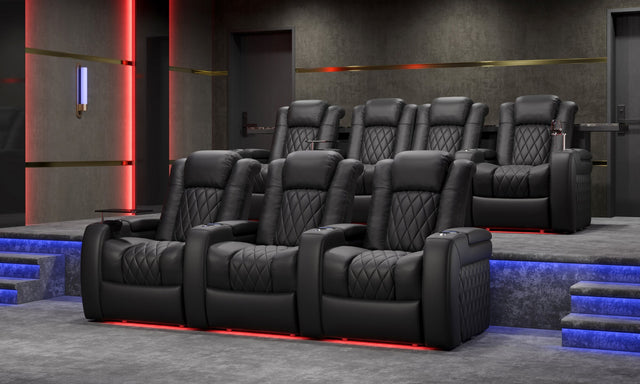
Row-of-3 or row-of-4 at floor level works cleanly in this room. A two-row option is possible: front row-of-2 or row-of-3 at floor level, back row-of-3 on a 10–12 inch riser, 42 inches of row spacing. Works well with a 110–120 inch screen at 12–14 feet viewing distance.
12×16 to 14×18 feet — Standard dedicated theater
Front row-of-3 or row-of-4 at floor level; back row-of-3 on a 12–16 inch riser; 42–48 inches between rows. 12–15 feet from front row to screen. 120-inch screen is ideal. Most comfortable for 5–7 seats total across two rows.
14×20 feet and larger — Full theater
Front row-of-4 or row-of-5 at floor level; back row-of-3 or row-of-4 on a 14–16 inch riser; 48 inches of row spacing; 13–16 feet from front row to screen. 120–150 inch screen. Three-row builds become possible in rooms with 22+ feet of depth.
5. Riser Planning for Two-Row Setups

Full-size theater recliner headrests reach 48–54 inches when upright. A rear row sitting at floor level will look at the backs of front-row headrests unless the screen is mounted unusually high. A riser is the standard solution.
Key riser dimensions
• Height: 12–18 inches is the standard range for two-row builds. Calculate from actual seat headrest height and rear viewer's seated eye height rather than assuming a standard number works.
• Depth: Must accommodate the seat's fully reclined footprint plus 4–6 inches of margin. For most power recliners, that means 52–62 inches of riser depth minimum.
• Ceiling clearance: Subtract your riser height from your ceiling height, then subtract seated head height (~54 inches). Aim for 12+ inches of headroom above the tallest seated occupant on the platform.
The full riser planning guide is at Do You Need a Theater Riser for Home Theater Seating?
6. The 35-Degree Sightline Rule

Any seat more than 35 degrees off screen center produces noticeable image distortion — perspective compression, color shift on older display types, and visible screen edge geometry. Commercial cinema seating standards (SMPTE) define the comfortable viewing cone as within 30 degrees of center for most of the audience.
Practical check for your row width
Draw your room to scale on graph paper (or use a layout app). Mark the screen center and both edges. Draw a line from each end seat position to the screen center. If the angle of either end-seat line exceeds 35 degrees from perpendicular to the screen, the row is too wide for the room depth.
• Row-of-3 in a 12-ft deep room: End seats typically sit at 20–25 degrees — comfortably within range.
• Row-of-5 in a 12-ft deep room: End seats can reach 35–40 degrees — check carefully before ordering.
• Rule of thumb: If the room is narrower than it is deep, wider rows may push end seats beyond comfortable angles. Consider a deeper room or a shorter row.
For more guidance on choosing the right seat count for your room, see How Many Seats Do You Need for Your Home Theater?
Frequently Asked Questions
How far back should theater seats be from the screen?
Multiply your screen diagonal (in inches) by 1.5 to 2.0 — the result is the optimal viewing range in inches. For a 120-inch screen, that's 180–240 inches (15–20 feet). Measure from the screen surface to the viewer's eye position, not the back wall.
Can I fit a row-of-5 in a standard living room?
A row-of-5 spans approximately 120–128 inches. Most 12–14-foot-wide rooms can accommodate this width, but the binding constraint is usually row depth (36–42 inches needed per row) and end-seat viewing angles. Always verify sightline angles before ordering a wide row for a room that isn't very deep.
What is the minimum ceiling height for a second-row riser?
A 12-inch riser in a room with an 8-foot ceiling leaves approximately 6'8" of headroom on the platform — workable for most people. For a 16-inch riser, headroom drops to 6'4", which can feel low for taller viewers. A 9-foot ceiling is significantly more comfortable for any two-row build. See the Theater Riser Guide for full calculations.
How much clearance should I leave on each side of the row?
Minimum 6 inches between the armrest and the wall on each side. 12 inches is comfortable and allows a person to walk past without turning sideways. In multi-row builds, leave 18–24 inches on at least one side as a primary aisle.
Do I need a wall-hugger model if my room is small?
Wall-hugger models are needed when the seat backs within 6 inches of a wall. Standard mechanisms require 18–24 inches of wall clearance behind the backrest to recline fully. If your room depth is tight, a wall-hugger seat buys back 12–18 inches of usable space behind the row.
How do I measure my room before buying seats?
Measure the usable width (wall-to-wall minus any protruding trim, HVAC, or built-ins). Subtract 12–24 inches for side clearance. The remainder is your maximum row width. Then measure front-to-back: subtract the space needed for the screen area, walking paths, and riser (if applicable). What remains must fit your row depth — 36–42 inches per row. For a complete planning checklist, see the Home Theater Room Setup Guide.
Can two different row sizes face the same screen?
Yes — mixing row sizes is common and functional. A row-of-3 in front and a row-of-4 on the riser (or vice versa) is a standard configuration. The rows don't need to match in size or configuration. Center the rows on the screen for the best sightline symmetry.