

In this article: how power and manual recliners compare across comfort, convenience, cost, and which to choose for your home theater.
- What Is a Power Recliner?
- What Is a Manual Recliner?
- Head-to-Head: Power vs. Manual
- Who Should Choose a Power Recliner
- Who Should Choose a Manual Recliner
- Frequently Asked Questions
Power recliners are the better choice for home theaters. They offer precise, motorized positioning with no physical effort — and for extended viewing sessions, that convenience is hard to overlook.

That said, manual recliners remain a solid option for tighter budgets or secondary seating. The right answer depends on how often you use the chair, who's using it, and how your room is set up. This guide breaks it all down so you can make the right call.
Quick Takeaways
• Power recliners give you hands-free control.
A button or hand remote adjusts the backrest and footrest independently — no pushing or pulling required.
• Manual recliners cost less but ask more of you.
You push back with your body weight or pull a lever — fine for occasional use, awkward during a movie.
• Power wins for long viewing sessions.
When you're watching a 2-hour film, motorized adjustments without leaving the moment beat manual mechanics every time.
• Power recliners need an outlet nearby.
Plan your room layout with power access in mind before buying.
• Theater-specific power recliners include features manual chairs don't.
Power headrests, USB charging, LED lighting, and lumbar heat are only possible in power models.
1. What Is a Power Recliner?

A power recliner uses an electric motor to move the backrest and footrest. Most models have at least two motors: one for the back, one for the legs. Premium models add a third motor for an independent power headrest.
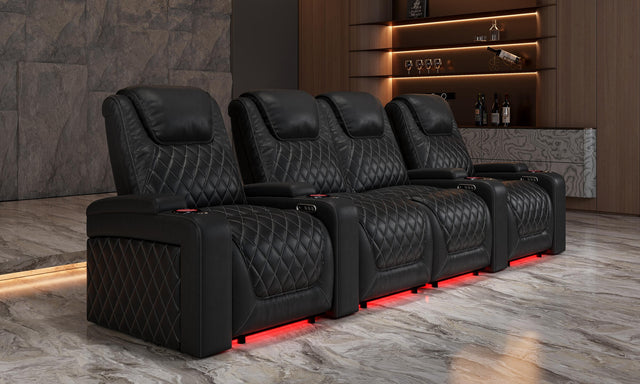
You control everything from a side panel, a hand remote, or — in theater-grade models — a dedicated controller with memory positions. Some Valencia models let you save two or three preferred positions so you can return to your favorite angle at the press of a button.
Key elements found in power recliners:
• Dual or triple motor systems: Each motor controls a separate zone — back, legs, and optionally the headrest — independently.
• Memory positions: Save your preferred angle and return to it instantly without guessing.
• USB charging ports: Built into the armrest or base, so your devices stay charged without leaving your seat.
• Integrated lighting: LED base lighting and backlit cup holders add ambiance without overhead lights.
• Add-on features: Massage, heat, and lumbar support are only possible on power platforms where the motor can coordinate multiple functions.
Power recliners from Valencia connect to a standard 110V outlet. The power cable typically routes beneath the seat, so you'll want an outlet within a few feet of the chair's position — or use a power strip along the baseboard.
2. What Is a Manual Recliner?

A manual recliner uses a lever, push mechanism, or pull strap to move the backrest and footrest. No electricity required. You use body weight to recline backward, then pull a lever or push a button to disengage the footrest.
Manual recliners are simpler mechanically, which can mean lower maintenance overhead over time. There are no motors to service, no power cables to manage, and no concern about electrical failures.
Types of manual reclining mechanisms:
• Lever mechanism: A handle on the side activates the footrest; leaning back adjusts the angle. Common in traditional recliners.
• Push-back mechanism: Body pressure reclines the chair; there's no lever. Footrest pops up automatically as the back goes down.
• Pull-strap mechanism: A strap beneath the seat releases the footrest. More common in loveseats and sectionals.
• Wall-hugger manual: Some manual recliners use a forward-sliding mechanism so they can be placed close to a wall, though most still require more clearance than power models.
For a home theater setup, manual recliners are generally a compromise. The act of leaning and adjusting mid-movie can interrupt the experience — and once you're reclined, getting back upright requires more effort than pressing a button.
3. Head-to-Head: Power vs. Manual

| Feature | Power Recliner | Manual Recliner |
|---|---|---|
| Adjustment control | Motor-driven | Lever or push-back |
| Independent back/leg | Yes | No — linked |
| Power headrest | Available (3-motor) | Not available |
| Outlet required | Yes (110V) | No |
| USB charging | Common | Rare |
| Massage / heat | Available | Not available |
| LED lighting | Available | Not available |
| Price range | Higher | Lower |
| Maintenance | Motor service needed | Mechanical only |
The independent back and leg adjustment is one of the most underrated advantages of power models. In a manual recliner, the back and footrest are linked — the footrest comes up as the back goes down, and you can't position them separately. In a power recliner, you can have the footrest elevated while the back stays upright, or vice versa. That flexibility matters for comfort during long sessions.
4. Who Should Choose a Power Recliner

Power recliners are the right call for most home theater buyers. Here's who benefits most:
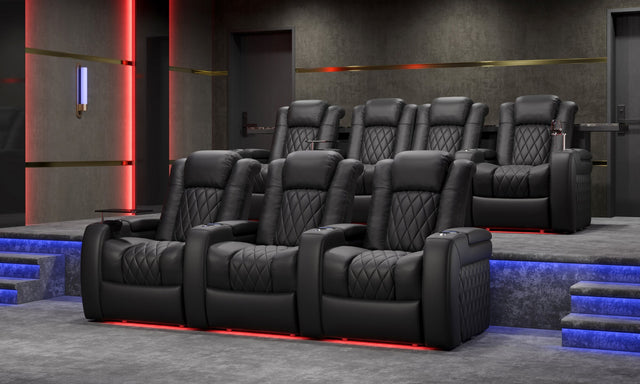
• Dedicated theater room owners: If the room is built for movies, invest in equipment that matches. A power recliner is as fundamental as a good speaker system.
• Users who watch 90-plus minute films regularly: Long sessions demand precise positioning. You'll want to adjust midway through without disrupting the experience.
• Anyone with limited mobility: Power recliners are significantly easier to get in and out of, especially models with a powered lift assist.
• Households where multiple people use the chair: Memory positions let each person save their preferred angle, so there's no readjusting every session.
• Buyers who want massage, heat, or LED lighting: These features are only available on power-platform models. If the full theater experience is the goal, manual won't get you there.
For help choosing between models, see our guide to home theater seating features.
5. Who Should Choose a Manual Recliner

Manual recliners aren't wrong — they're just a different tradeoff. They make sense in specific situations:
• Tight budget: Manual mechanisms cost less to manufacture. If you're furnishing a room on a firm number, manual frees up budget for screen or audio.
• No outlet access near the seating area: Power recliners need a power source nearby. If running cable isn't possible, manual avoids the problem entirely.
• Occasional or casual use: A guest bedroom or secondary media space that sees light use doesn't justify the cost premium of a power model.
• Preference for simpler mechanics: Some buyers prefer mechanisms with fewer electronic components. If long-term serviceability is a priority and you don't need power features, manual is a defensible choice.
If you're planning a full theater room, see our room setup guide for layout and seating recommendations before deciding.
Frequently Asked Questions
Do power recliners use a lot of electricity?
No. Most power recliners draw only 50–150 watts while the motor is actively running — comparable to a laptop. During a movie, the motor runs for seconds at a time, so actual energy use is minimal.
Can a power recliner work without power?
Only in the position it was in when power was lost. Some models include a battery backup that lets you return the chair to an upright position in the event of an outage. Check product specs before buying if this matters to you.
Are manual recliners harder to get out of?
Yes, generally. Getting out of a manual recliner requires you to close the footrest, then push yourself upright. Power recliners do this for you, which makes a meaningful difference after long sessions or for users with limited mobility.
What is a power headrest and do I need one?
A power headrest is a motorized neck cushion that adjusts independently from the backrest. It's particularly useful when watching in a more upright position — you can angle the headrest forward to support your neck without changing the back angle. It's a worthwhile upgrade for theater seating. Learn more in our home theater seating features guide.
How close to the wall can a power recliner be placed?
Power recliners, including Valencia's Oslo and Tuscany models, use a wall-hugger mechanism that requires as little as 3–6 inches of clearance from the wall. See our layout and row spacing guide for exact clearance measurements.
Do power recliners have more features than manual?
Yes. Features like massage, heat, LED base lighting, USB charging, and motorized headrests are only available on power-platform models. If you want any of these, you'll need a power recliner.
Which Valencia models are power recliners?
All of Valencia's theater seating models — the Tuscany, Oslo, Barcelona Grand, Naples, Piacenza, and others — are power recliners. See the full home theater seating collection or read our Tuscany vs. Barcelona vs. Oslo comparison to find the right model.
What's the difference between a 2-motor and 3-motor recliner?
A 2-motor recliner controls the backrest and footrest independently. A 3-motor model adds a motorized headrest, allowing neck angle adjustment without changing the back position. For home theater use, a 3-motor model is preferable because you'll want to control head position while watching.