

In this article: what wall hugger recliners are, how the forward-slide mechanism works, how much space you actually save, and which Valencia models use it.
- What Is a Wall Hugger Recliner?
- How the Mechanism Works
- How Much Space Do You Actually Save?
- Wall Hugger vs. Standard Recliner
- Which Valencia Chairs Are Wall Huggers?
- Frequently Asked Questions
A wall hugger recliner slides forward as it reclines, so the back of the chair moves away from the wall as the seat moves toward it — keeping the total clearance needed to just 3 to 6 inches. That's a significant reduction compared to the 12 to 18 inches a standard recliner typically requires.

For home theater rooms where every inch counts, the wall hugger mechanism is one of the most practical features to understand before you buy. This guide explains how it works, what the actual space savings look like, and which Valencia models qualify.
Quick Takeaways
• Wall hugger recliners need only 3–6 inches of wall clearance.
Standard recliners require 12–18 inches. On a 14-foot room depth, that difference can determine whether you fit two rows or one.
• The mechanism slides the seat forward to compensate for the reclining motion.
Rather than pushing the back straight back, the entire chair shifts forward so the headrest doesn't require extra space behind the seat.
• Power wall huggers are more precise than manual ones.
A motorized mechanism controls the slide movement smoothly and returns to the exact upright position every time.
• All Valencia home theater chairs are wall huggers.
The Oslo, Tuscany, Barcelona Grand, and Naples are all designed with the forward-slide mechanism for installation in tight rooms.
• Measure from the back of the chair frame, not the back of the cushion.
Clearance measurements refer to the chair's structural frame. Always use the spec sheet measurement rather than a visual estimate.
1. What Is a Wall Hugger Recliner?

A wall hugger recliner — also called a wall-away recliner or space-saver recliner — is designed to be placed with minimal clearance from the wall behind it. While a traditional recliner's back pushes straight backward when the footrest opens, a wall hugger's seat slides forward instead, keeping the chair's total footprint essentially unchanged when reclined.
The key distinction is motion direction.
In a standard recliner:
• The footrest extends outward from the front of the chair.
• The backrest tilts backward toward the wall, requiring open space behind the chair.
In a wall hugger:
• The footrest extends outward from the front of the chair (same as standard).
• The seat glides forward on a track mechanism, so the back reclines without moving toward the wall.
The result: The back of the chair stays in roughly the same position it was in when upright. You get the full reclining angle — typically 150–170 degrees — without needing extra wall clearance.
2. How the Mechanism Works

The wall hugger mechanism uses a linked track and pivot system beneath the seat. When you activate the recliner (via motor or lever), the seat base slides forward on the track while the backrest simultaneously tilts. The two movements are mechanically linked so they happen in proportion — the more the back reclines, the further forward the seat travels.
In power models, a motor drives both movements simultaneously through a single actuation. The mechanism is smoother and more repeatable than a manual version. In manual wall huggers, the user initiates both movements with a lever, which can sometimes feel less coordinated.
Important factors in mechanism quality:
• Track length: A longer track allows a deeper recline without requiring extra clearance. Better chairs have longer travel distance on the track.
• Frame construction: The track and pivot points are high-wear areas. Look for steel construction with reinforced attachment points rather than plastic guides.
• Motor quality (power models): The motor that drives the slide mechanism should be rated for continuous-duty use, not just periodic actuation. Valencia uses commercial-grade motors with multi-year ratings.
3. How Much Space Do You Actually Save?

The space savings of a wall hugger are real — but it's important to understand what "clearance from the wall" actually means in practice.
| Recliner Type | Min. Wall Clearance | Notes |
|---|---|---|
| Standard recliner | 12–18 in | Back pushes straight toward the wall when reclining |
| Wall hugger manual | 4–8 in | Seat slides forward; back stays in place |
| Wall hugger power | 3–6 in | Motor-controlled slide; smoother and more precise |
| Valencia Oslo / Tuscany | ~3 in | Designed specifically for theater room installation |
For a two-row theater room, saving 12–15 inches of clearance per row can be the difference between a viable layout and a cramped one. See the layout and row spacing guide for how this plays out in real room dimensions.
One practical note: wall clearance refers to the back frame of the chair, not the back cushion. The cushion typically extends a few inches further back than the structural frame. When measuring, use the listed specification for "wall clearance" from the product sheet — not a visual estimate from the cushion edge.
4. Wall Hugger vs. Standard Recliner

| Feature | Wall Hugger | Standard Recliner |
|---|---|---|
| Wall clearance needed | 3–8 in | 12–18 in |
| Mechanism complexity | Track + pivot + motor | Simpler pivot only |
| Seated footprint when upright | Standard | Standard |
| Reclined footprint | Similar to upright | Significantly wider |
| Best use | Dedicated rooms, tight spaces | Open floor plans |
In a living room with no wall directly behind the seating, a standard recliner is fine. In a dedicated theater room with a back wall, a wall hugger is nearly always the right choice. For help planning your layout, see our room setup guide.
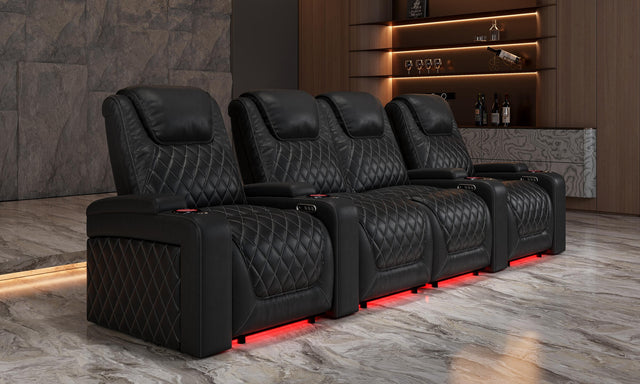
5. Which Valencia Chairs Are Wall Huggers?

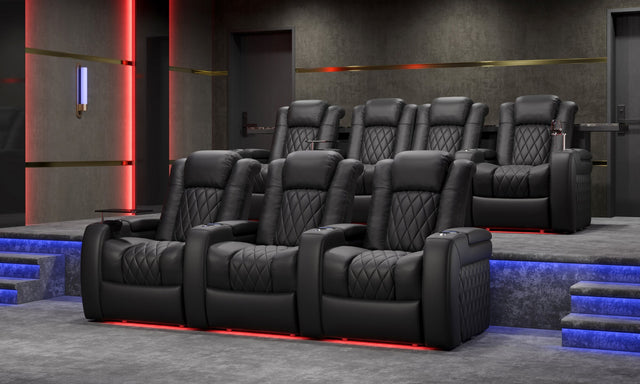
Every Valencia home theater chair uses a wall-hugger mechanism. This is by design — Valencia builds specifically for dedicated theater rooms where wall-to-wall installation is common.
• Valencia Oslo: 3-inch wall clearance, motorized forward-slide mechanism, available in single and row configurations.
• Valencia Tuscany: 3-inch wall clearance, identical forward-slide mechanism, available in single, loveseat console, and row configurations.
• Valencia Barcelona Grand: Slightly larger form factor but still uses the wall-hugger design. Check the spec sheet for exact clearance on the model you're considering.
• Valencia Naples: Wall-hugger design with the same 3-inch clearance target. Available in several leather grades and color options.
When comparing models, use the Tuscany vs. Barcelona vs. Oslo comparison guide to see side-by-side specs. For room planning with exact dimensions, see the layout and spacing guide.
Frequently Asked Questions
How close to the wall can a wall hugger recliner be placed?
Valencia's wall hugger models require as little as 3 inches of clearance from the wall to the back frame of the chair. This applies to the Oslo, Tuscany, and other models in the lineup. Always confirm with the spec sheet for your specific model.
Are wall hugger recliners as comfortable as standard recliners?
Yes. The wall hugger mechanism only changes how the chair moves, not the reclining angle or cushion depth you end up in. You reach the same reclined position — the chair just gets there by sliding forward rather than pushing back.
Does the wall hugger mechanism affect durability?
It adds mechanical complexity — there's a track system in addition to the standard pivot and motor. Higher-quality chairs use steel tracks with reinforced guides. Valencia uses commercial-grade mechanisms rated for extended use.
What is the minimum room depth needed for a home theater with wall hugger recliners?
This depends on seat depth, row spacing, and screen distance. For a single row, a room depth of 12–14 feet is typically sufficient. For two rows, 18–22 feet is more realistic. See the layout and row spacing guide for detailed calculations.
Can I place a wall hugger recliner directly against the wall with no gap?
No. Even with a wall hugger, you need a few inches of clearance so the backrest mechanism doesn't contact the wall during the reclining motion. The spec sheet will list the minimum required gap — for Valencia models, this is typically 3 inches.
Is the Oslo or Tuscany better for small rooms?
Both use the same wall-hugger mechanism with the same minimum clearance. The Oslo is slightly smaller in width per seat, which can help in narrow rooms. Read the full model comparison guide to see which fits your room dimensions.
Do wall hugger recliners work in open-plan living rooms?
Yes, though their benefit is less critical in open floor plans. Wall huggers are specifically valuable when the seating must be positioned against or near a wall. In a living room with open space behind the sofa, a standard recliner works equally well.