

In this article: A direct comparison of home theater seating and recliners — what each is engineered to do, where the tradeoffs fall, and which is the right choice for your room and how you actually watch.
- What Theater Seating Is Designed to Do
- What a Recliner Is Designed to Do
- Key Differences Between Them
- When Theater Seating Is the Better Choice
- When a Recliner Is the Better Choice
- Frequently Asked Questions
Theater seating and recliners solve the same problem — seated comfort during long viewing sessions — but they solve it with completely different engineering priorities. Theater seats are designed around a fixed screen orientation, shared row configurations, and cinema-specific features. Recliners are designed for individual comfort in any room layout and any body position. Neither is universally superior; the right choice depends on how the room is used.

This guide lays out what distinguishes the two categories in practice — not in marketing language — and gives you a concrete decision framework based on room type, household size, and typical use patterns. For a broader overview of seating options see the How to Choose Home Theater Seats guide.
Quick Takeaways
• Theater seating is optimized for the room first, the viewer second.
Row spacing, sight-line clearance, and shared armrest configurations are engineered around the screen's position — not around individual preferences.
• Recliners are optimized for the viewer first, the room second.
Individual positioning, standalone form factor, and orientation flexibility prioritize per-person comfort over coordinated viewing configurations.
• The most important question is whether your room is dedicated or multipurpose.
Dedicated theater rooms are built for theater seating. Rooms that serve multiple functions are better served by versatile recliners or recliner-sofa configurations.
• Modern theater seats blur the line more than older ones did.
Power recliners with LED lighting, USB charging, and a living-room-appropriate profile now occupy the space between both categories — particularly the Valencia Oslo and Barcelona Grand.
• You do not have to choose.
Theater seats in a single flexible row function as premium recliners in a media room setting — especially the Oslo Row-of-2 configuration as a sofa replacement.
1. What Theater Seating Is Designed to Do

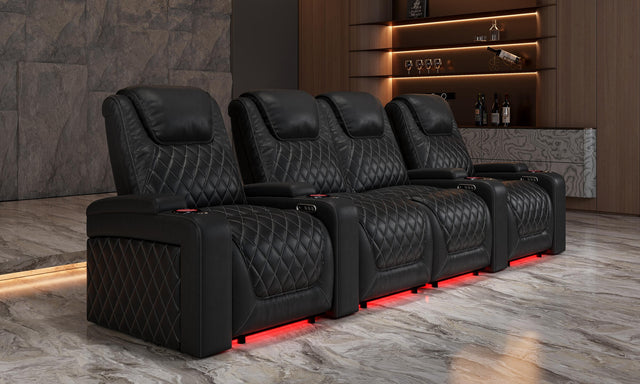
Theater seating is designed as a system, not as a collection of individual chairs. Every dimension — seat width, row spacing, recline trajectory, headrest height — is calibrated to deliver a consistent sight line to a fixed screen from a fixed position in the room.
What theater seating is engineered for:
• Fixed viewing orientation: All seats in a row face the same direction at the same angle. There is no ambiguity about where to look — the screen is always straight ahead at the correct distance and viewing angle from every seat in the row.
• Row coordination: Shared armrests between adjacent seats, matching seat heights, and synchronized recline trajectories mean that every person in a row reclines to the same angle, preventing one viewer's position from obstructing another's sight line.
• Cinema-specific features: Cup holders positioned at the optimal arm reach, tray tables sized for snacks, USB charging at seat level, and LED ambient lighting designed to function in a dark room without washing out the screen — these features are purpose-designed for the viewing context, not repurposed from furniture conventions.
• Dimensional precision: Theater seat manufacturers publish reclined depth, seat height, and total row width dimensions specifically so builders can design rooms around them. This level of specification does not exist in most furniture-grade recliners.
Theater seating's greatest strength is also its constraint: it delivers a superior coordinated viewing experience when the room is configured specifically for that purpose. Placed in an open floor plan or used as standalone chairs without a dedicated screen orientation, the theater seat loses most of its design advantages.
2. What a Recliner Is Designed to Do

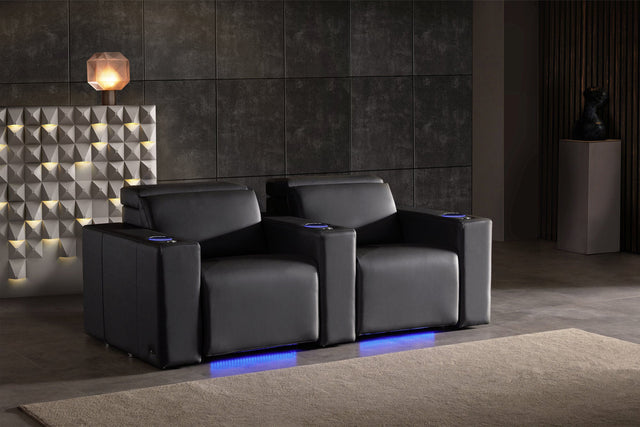
A recliner is a standalone piece of furniture designed to transition an occupant from an upright seated position to a partially or fully reclined position. Its design priorities are individual comfort, position variety, and room flexibility — not coordination with adjacent seats or optimization for a specific viewing distance.
What recliners are engineered for:
• Individual position flexibility: Traditional recliners offer an infinite range of positions from fully upright to flat reclined. Power recliners add motorized adjustment, memory positions, and often independent footrest and backrest controls that theater seats do not typically replicate.
• Room orientation independence: A recliner works in any position in any room, facing any direction. It does not require alignment with a screen or coordination with adjacent seating — it is furniture first, viewing seat second.
• Standalone footprint: Recliners do not require shared armrests, row platforms, or coordinated installation. Each piece is independent, which makes recliner configurations easier to change as the room's use evolves.
• Living room integration: Recliners are designed to work alongside sofas, coffee tables, and other furniture in a traditional room layout. Their silhouette is typically more living-room-appropriate than dedicated theater chairs when not in use.
The recliner's flexibility makes it the better default for any room that does not have a fixed screen orientation or is used for activities beyond viewing. Its design does not assume the viewer will always be in the same position facing the same direction — which is both its strength in multipurpose rooms and its limitation in dedicated theaters.
3. Key Differences Between Them

| Factor | Theater Seating | Recliner |
|---|---|---|
| Design orientation | Fixed, screen-facing | Flexible, any direction |
| Armrests | Shared between seats in a row | Independent per chair |
| Row coordination | Yes — synchronized experience | No — each seat independent |
| Cinema features | Built in (cupholders, LED, USB) | Varies by model |
| Room requirement | Fixed screen orientation | Any room layout |
| Installation | Row configuration, power per row | Standalone, plug-in per chair |
| Reconfigurability | Low — rows are built configurations | High — each piece movable |
| Best use case | Dedicated theater room | Multipurpose living room |
The blurring of these categories is happening at the premium end of both markets. Modern theater seats like the Oslo and Barcelona Grand have profiles and feature sets that work well in non-theater living spaces. Premium power recliners increasingly include cup holders, USB charging, and LED lighting that were once exclusive to theater seats. For buyers in the $1,000–$1,500 per seat range, the decision is often less about category and more about which specific model fits the specific room.
4. When Theater Seating Is the Better Choice

Theater seating outperforms recliners in specific conditions. When these conditions are met, the difference is pronounced enough to justify the additional installation and planning overhead.
Theater seating is the clear choice when:
• The room has a fixed screen: A projector and screen or a wall-mounted TV with a defined viewing position. When all viewers in the room are consistently oriented toward the same fixed point, theater seating's row coordination and sight-line engineering deliver a meaningfully better experience than individual recliners placed informally.
• Multiple viewers watch together regularly: Theater seating's shared row format means that two people in adjacent seats recline in coordination rather than independently, eliminating the sight-line disruption that occurs when one person reclines in front of another in an individual recliner setup.
• The room is dedicated to viewing: Acoustic treatment, dark paint, and a fixed screen orientation define a dedicated theater room. Theater seating integrates into this environment as a functional component rather than as furniture placed in front of a TV.
• You want cinema-level immersion: The combination of fixed rows, sight-line accuracy, ambient LED lighting, and a dark controlled environment produces an experience that individual recliners in an open room cannot replicate — regardless of the recliners' quality. See the Home Theater Room Setup Guide for how the full system works together.
5. When a Recliner Is the Better Choice

Recliners — including theater-adjacent models like the Barcelona Grand placed as standalone seats — outperform fixed theater seating configurations in several specific scenarios.
A recliner is the better choice when:
• The room has no fixed screen orientation: A living room where the TV position changes, or where viewers sit in multiple different orientations depending on the activity. Theater seating's advantages disappear when there is no fixed directional reference point.
• Viewers have significantly different position preferences: One person wants to be fully flat; another wants to sit upright; a third wants the footrest up but the back relatively straight. Individual recliners accommodate this variation without affecting adjacent viewers. Shared theater rows do not.
• The room layout will change over time: Households that anticipate moving, reconfiguring, or repurposing the entertainment space benefit from standalone recliners that can move with the room rather than theater configurations that are semi-permanent.
• Single-occupancy viewing dominates: One person watching alone in a room gains little from the row-coordination advantages of theater seating. A single premium recliner positioned at the correct viewing distance delivers equivalent or better individual comfort than a theater seat at the end of an otherwise empty row.
• Budget requires prioritizing other components first: Recliners can be added one at a time as budget allows. Theater row configurations require buying the full row at once to achieve the intended visual coherence. See the Home Theater Budget Guide for how to phase a room build over time.
Frequently Asked Questions
Can theater seats be used as regular recliners?
Yes. A theater seat placed as a standalone chair in a living room functions as a power recliner with additional features — cup holders, USB charging, LED lighting — that most standalone recliners do not include. The visual difference is that theater seats tend to have a more dramatic silhouette than living-room-style recliners, which some households prefer and others find too theatrical for a non-dedicated space. The Oslo in particular has a profile that reads as premium furniture rather than cinema equipment.
Do recliners work well for home theaters?
Individual recliners work for casual home viewing, but they lack the coordination and dimensional engineering that makes theater seating effective in a purpose-built room. When two recliners are placed next to each other, one person's recline can block the other's sight line. Shared armrests are absent, which increases the seated-to-seated distance. And there is no guarantee that the recline trajectory keeps the viewer's eye level within the optimal screen angle. For a casual media room, recliners are fine. For a dedicated theater, theater seating is the correct tool.
What is the main advantage of theater seating over recliners?
Row coordination. Theater seats in a row are designed to recline together without obstructing adjacent viewers, maintain uniform sight lines to the screen, and keep every viewer at the same height and angle relative to the display. This coordination is only relevant when multiple people watch together regularly in a fixed-screen room — but in that context, it makes a meaningful difference in the experience quality for every viewer in every session.
How much clearance do theater seats need from the wall?
Most power theater seats require 2–4 in of clearance behind the seat back to the wall when in the upright position, and more clearance when fully reclined (typically 6–10 in). Wall-hugger recliner mechanisms, available on some models, recline forward and inward rather than backward, reducing the rear clearance requirement to near zero. For theater rows positioned against a rear wall, verify the specific model's reclined depth against the available clearance before purchasing. See the Layout and Row Spacing Guide for rear-wall clearance calculations.
Are theater seats more expensive than recliners?
At equivalent quality levels, theater seats and premium power recliners occupy similar price ranges. A single Valencia theater seat starts at $1,059–$1,279 depending on model; premium power recliners from furniture brands in comparable top-grain leather run $800–$1,500 per unit. The price difference narrows or reverses at the luxury end of both markets. The key cost difference is usually that theater seats are purchased as a coordinated row (multiplying the per-seat cost) while recliners are purchased individually.
What if some family members want theater seats and others want recliners?
A theater seat row of two or three seats combined with a supplemental standalone recliner or chair at the side of the room is a practical hybrid solution. The primary viewers get theater seating with all its coordination advantages; secondary viewers get individual positioning flexibility. This is common in media rooms where a sofa or sectional supplements a dedicated theater row. The Home Theater Layout Ideas guide covers mixed-seating configurations for rooms with multiple viewer preferences.
Do theater seats hold up better than recliners over time?
Longevity is more dependent on construction quality and leather grade than on category. A top-grain leather theater seat from a quality manufacturer will outlast a bonded-leather recliner regardless of price. Both categories have models built for 10–15 years of daily use and models built for 3–5 years. When evaluating durability, prioritize leather grade (top-grain over bonded), frame construction (kiln-dried hardwood over plywood or particle board), and mechanism quality over whether the seat is labeled a theater seat or a recliner.
Can I put theater seats in a living room without making it look like a cinema?
Yes, particularly with models like the Valencia Oslo, which has a low-profile modern silhouette that reads as premium furniture rather than cinema equipment. A Row-of-2 Oslo with a center console functions visually as a loveseat replacement — the LED lighting and cup holders are present but unobtrusive when not in use. Avoiding overtly theatrical details like stepped platforms, column lighting, or heavily branded rows keeps the room feeling like a living space rather than a converted basement theater.