

In this article: Practical seating and screen configurations for small, medium, and large rooms — including mixed-use spaces and when to add a riser.
- Small Rooms — 10 to 12 ft Wide
- Medium Rooms — 12 to 14 ft Wide
- Large Rooms — 14 ft and Wider
- Mixed-Use Rooms
- When to Add a Riser
- Frequently Asked Questions
The right home theater layout is the one that fits your specific room — not the one that looks best in a showroom. Screen size, seat count, row spacing, and riser decisions all flow directly from your room's width and depth. This guide gives you concrete configurations for four common room types, with the numbers to back them up.

Whether you are starting from scratch or adapting an existing space, use these layouts as a starting framework, then adjust for your specific dimensions. For detailed row spacing calculations and seat count formulas, see the companion Layout and Row Spacing Guide.
Quick Takeaways
• Small rooms work well with a single row of two or three seats.
Focus budget on a 100-in screen and a quality single row rather than stretching for two rows the room cannot comfortably support.
• Medium rooms open up the most layout options.
A 12–14 ft wide room can support a single row of four or a two-row setup depending on depth, giving you flexibility as needs change.
• Large rooms reward two-row layouts with a riser.
At 14 ft+ wide and 20+ ft deep, a riser and second row deliver a true cinema-style experience that smaller rooms simply cannot replicate.
• Mixed-use rooms need flexible seating, not fixed theater chairs.
Rows without a wall anchor, movable configurations, and seats that work as standalone pieces make dual-purpose rooms more functional.
• Risers cost more than most people budget for.
Factor in framing, electrical for the raised row, carpet, and safety lighting before deciding whether a riser fits your project scope.
1. Small Rooms — 10 to 12 ft Wide

Small rooms require the most disciplined layout decisions. The goal is to maximize viewing quality within tight constraints — not to force a two-row setup that the room's dimensions cannot support properly.
Recommended configuration — Row of 2 or 3:
• Screen size: 100–110 in diagonal. This keeps the front row's viewing angle within SMPTE guidelines at a 10–12 ft viewing distance.
• Seat count: Two seats in a 10 ft room; three seats in an 11–12 ft room. At 22–24 in per seat body plus shared armrests, three seats in 10 ft leaves inadequate side clearance.
• Row depth: Position the seat row 10–12 ft from the screen surface. Closer than 9 ft on a 100-in screen produces an uncomfortable viewing angle for most people.
• Riser: Not recommended for rooms under 16 ft deep. Adding a second row at proper 48–54 in spacing leaves the rear row too close to the back wall for acoustic rear-wall treatment.
| Room Width | Seats Per Row | Screen Size | Notes |
|---|---|---|---|
| 10 ft | 2 seats | 100 in | 12 in clearance per wall with 22-in seats |
| 11 ft | 2–3 seats | 100–110 in | 3 seats tight; consider loveseat-style pairing |
| 12 ft | 3 seats | 110 in | 15 in clearance per wall — comfortable |
In small rooms, seat width selection matters more than in larger spaces. A 22-in seat body (such as the Oslo or Tuscany) provides meaningfully more clearance per wall than a 26-in seat without any reduction in comfort for most adults.
2. Medium Rooms — 12 to 14 ft Wide

Medium rooms offer the widest range of layout options. At 12–14 ft wide and 18–22 ft deep, you can run a generous single row of three to four seats, or a two-row setup if the room's depth supports the required spacing. Settling this question early determines whether a riser belongs in your build.
Single-row configuration — best for rooms under 20 ft deep:
• Seat count: Three to four seats depending on width. A 14 ft room fits four 22-in seats with 15–18 in of side clearance per wall.
• Screen size: 110–120 in diagonal. A 120-in screen at 14 ft viewing distance falls within THX's recommended 36° horizontal viewing angle from the center seat.
• Row placement: 12–14 ft from screen to front row eye position. Center the row laterally — equal distance from each side wall produces the most balanced stereo image from the primary listening position.
Two-row configuration — requires 20+ ft of depth:
• Row spacing: 54 in between seat backs, front row to back row. This allows full power recline in both rows without interference.
• Riser for second row: 12–16 in recommended in rooms with 8–9 ft ceilings. Higher risers require more ceiling clearance for rear-row occupants in the reclined position.
• Aisle width: Minimum 18 in between the outermost seat and the side wall on at least one side to allow exit from the second row without climbing past the first row.
3. Large Rooms — 14 ft and Wider

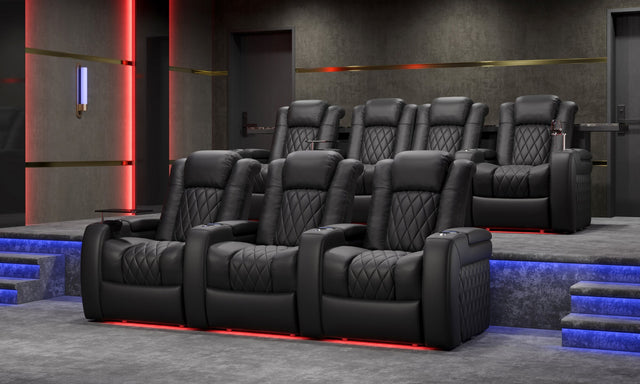
Large rooms unlock configurations that smaller spaces cannot support: two full rows of three or four seats, a proper elevated riser, and enough rear clearance for full acoustic rear-wall treatment. This is the room size where a purpose-built theater becomes a genuinely cinematic experience rather than a well-equipped living room.
Two-row layout — the standard for large rooms:
• Front row — 3 to 4 seats: Place the front row 12–14 ft from the screen. At this distance a 120–135-in screen delivers a viewing angle that fills peripheral vision without requiring head movement to follow action at screen edges.
• Second row — 3 to 4 seats on riser: Position the second row 48–54 in behind the front row seat backs. The riser height (12–18 in) is determined by the sight-line clearance calculation — rear row eye level must clear front row headrests by at least 3 in when the front headrests are at maximum extension.
• Row-to-back-wall clearance: Leave at least 18–24 in from the rear seat back to the back wall. This space is needed for acoustic rear-wall treatment and makes the room feel less closed-off from the second row.
Staggered seating: In rooms wide enough to support four or five seats per row, staggering the second row laterally by half a seat width improves sight lines for every rear-row viewer. This requires a wider riser platform — calculate the required platform depth by adding the seat body depth plus 6 in of toe clearance at the riser edge.
Screen size for large rooms:
| Room Depth | Screen Recommendation | Front Row Distance |
|---|---|---|
| 20–22 ft | 120–125 in | 12–13 ft from screen |
| 22–26 ft | 125–135 in | 13–15 ft from screen |
| 26 ft+ | 135 in+ | 14–16 ft; long-throw projector required |
4. Mixed-Use Rooms

Mixed-use rooms — spaces that serve as both a theater and a living area, game room, or family room — require a different layout philosophy. The goal is a configuration that performs reasonably well for dedicated viewing while remaining functional for other activities the rest of the time.
Seating strategy for mixed-use rooms:
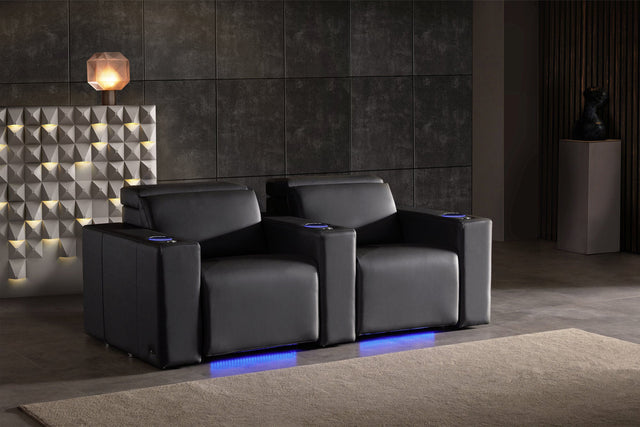
• Prioritize flexible configurations over fixed rows: A row of two power recliners with a center console performs well for theater viewing and occupies a footprint closer to a loveseat than to traditional theater furniture. The Oslo Row-of-2 configuration, for example, reads as a premium sofa replacement rather than a dedicated theater installation.
• Avoid wall-anchored risers: A raised platform is a permanent architectural element. Mixed-use rooms benefit from seating that can be repositioned as the room's use evolves.
• Side and rear seating zones: In an open floor plan, supplemental chairs or ottomans arranged at the sides of the primary row allow a mixed-use room to accommodate more viewers for event-style viewing without requiring a full theater row layout.
Display strategy for mixed-use rooms: Large-format TVs (85–100 in) perform better than projectors in rooms with ambient light. A motorized mount that tilts the screen toward different seating zones adds functional flexibility. If you want a projector, an ambient-light-rejecting (ALR) screen paired with a high-lumen lamp projector can handle moderate daylight — but no projector and screen combination matches a large TV for all-conditions ambient light performance.
Lighting zones: Mixed-use rooms benefit from at least two dimmer zones — one for general room lighting and one for the viewing zone behind and beside the screen. Being able to light the room for conversation without illuminating the screen area directly makes the space feel intentional rather than compromised.
5. When to Add a Riser

A riser is worth building when three conditions are met: the room is deep enough to accommodate two proper rows with spacing, the ceiling is high enough to allow the rear row's seated head clearance at riser height, and sight lines from the second row cannot be solved by staggering seats laterally. When all three apply, a riser transforms the second-row experience from a compromised viewing position to a legitimate primary seat. For a full riser planning guide see Do You Need a Theater Riser.
Riser build checklist:
• Sight-line clearance check: With front row headrests at maximum extension, measure from the floor to the top of the headrest. Add 3–4 in clearance. That is your minimum rear-row eye-level height. Riser height equals that number minus the seated eye height of an average-height occupant (approximately 44–48 in from floor to eye when seated).
• Ceiling clearance check: Add riser height to the seated occupant's total reclined height (seat height plus head height when reclined, typically 48–52 in). Confirm this sum is at least 18 in below the finished ceiling.
• Riser depth: Platform depth equals seat body depth plus 6 in toe clearance at the front edge plus any walkway or aisle required at the back. Most theater seats have a body depth of 38–44 in reclined — budget 50 in minimum platform depth.
• Structural load: A two-row riser carrying three seats plus occupants can weigh 1,800–2,400 lbs. Confirm the floor structure can handle this concentrated load or add blocking between joists before building the platform.
• Aisle lighting: Building code in most jurisdictions requires step illumination on riser stairs serving an occupied space. Plan this wiring during the rough-in phase — not after the riser is framed and drywalled.
Frequently Asked Questions
How do I know if my room can support two rows?
The minimum depth for a two-row layout is approximately 22 ft: 13 ft for front-row viewing distance, 54 in for row spacing, 18 in for the riser-to-back-wall clearance, and another 12 in for acoustic rear-wall treatment. If your room is shorter than 20 ft, a well-configured single row will deliver better results than two cramped rows.
How many seats fit in a 12 ft wide room?
A 12 ft room comfortably fits three 22-in seats in a row with approximately 15 in of side clearance per wall. Wider seats (26 in) reduce clearance to about 9 in per side, which is workable but tight. Four seats in 12 ft is generally not feasible without sacrificing minimum side clearance. See How Many Seats Do You Need for a full width-to-count table.
Can I put theater seats in a living room?
Yes. A row of two or three theater seats with a center console fits the footprint of a standard sofa and provides significantly better individual comfort for long viewing sessions. The key consideration in an open living room is that power recline requires clearance behind the seat — most power recliners need at least 6–8 in from the seat back to a wall or obstruction when fully extended.
What is the minimum ceiling height for a second row on a riser?
With a 12-in riser and standard theater seats, you need a minimum of 8 ft of finished ceiling height in the raised section. A 16-in riser requires at least 8.5 ft. Taller occupants and seats with power headrests at full extension need additional headroom — always calculate using the specific seat's maximum reclined height dimension, not a generic estimate.
Does the screen need to be centered on the wall?
Yes — the screen should be centered on the wall, and the primary seating row should be centered on the screen. This alignment produces the most accurate stereo and surround sound image from the center seat and ensures all viewers have equal viewing angles. Off-center screen placement creates unequal speaker distances that are difficult to correct even with room correction DSP software.
Should I use a projector or TV in a mixed-use room?
A large-format TV (85–100 in) is the more practical choice for rooms with ambient light. Projectors require either near-total darkness or an ALR screen plus a high-lumen lamp to compete with daylight. In a room used for multiple purposes throughout the day, a TV eliminates the blackout window and curtain requirement and provides a better experience for sports, gaming, and casual viewing. If cinema quality is the priority even in mixed-use, an ALR screen with a 3,500+ lumen laser projector is the best compromise. For more on screen vs. projector tradeoffs see the Home Theater Room Setup Guide.
How much does building a theater riser cost?
A basic DIY riser — 2×6 framing, plywood deck, carpeted surface — costs $300–$800 in materials for a two-seat width. A professionally built and finished riser with drywall fascia, integrated step lighting, and carpet to match the room runs $1,500–$4,000 depending on size and finish quality. Factor in the cost of extending the seat-row electrical circuit to the riser platform as part of the total budget.
Which seat models work best in small rooms?
In tight rooms, prioritize seats with the smallest documented reclined depth and the narrowest seat body. The Valencia Oslo and Tuscany both have 22-in seat bodies and well-documented reclined dimensions. Compare seat specifications against your available row depth before ordering. For a full feature-by-feature comparison see Home Theater Seating Features That Actually Matter.