

In this article: Everything you need to know before buying a power recliner — drive mechanisms, recliner categories, seat configurations, wall clearance requirements, and leather grades explained plainly.
- Power vs. Manual — Which Drive Mechanism to Choose
- Theater Recliners vs. Living Room Recliners
- Single Seat vs. Loveseat Configurations
- Wall-Hugger vs. Traditional Recliners
- Leather Grade and Long-Term Value
- Frequently Asked Questions
The recliner market spans a wider range of quality, mechanism type, and use case than almost any other furniture category — and most buyers do not realize this until after they have made a purchase they regret. Understanding the five key decision variables before you shop eliminates most of the common mistakes: under-specifying the drive mechanism, buying the wrong size for the room, and overestimating how much a cheap leather grade will hold up over time.

This guide covers the full spectrum from basic manual recliners to theater-grade power recliners with heated seats and massage. It is written for buyers at every budget level — not just the premium tier. If you already know you want a theater-specific recliner, see the Theater Seating vs. Recliners comparison for a head-to-head breakdown of the two categories.
Quick Takeaways
• Power recline is worth the premium for almost every buyer.
The ability to adjust recline angle precisely — without shifting body weight to pull a lever — pays off during long sessions and makes the chair significantly easier for older or less mobile users.
• Measure rear clearance before buying a non-wall-hugger.
Traditional recliners need 12–18 in of rear clearance when extended. Wall-hugger mechanisms need 4–6 in. Getting this wrong means the chair cannot fully recline in the space you have.
• Leather grade is the most important long-term value factor.
A top-grain leather recliner will outlast a bonded leather recliner by 5–8 years under the same use conditions. The price difference is real at purchase but recedes quickly over the ownership period.
• Theater recliners justify their price through feature density.
USB charging, cup holders, ambient LED lighting, and power headrests are rare in living-room recliners at any price point — they are standard in purpose-built theater models.
• Loveseat configurations save floor space but reduce per-person adjustability.
Two seats sharing a center console occupy less floor space than two independent chairs — but the shared armrest limits individual positioning variation between the two occupants.
1. Power vs. Manual — Which Drive Mechanism to Choose

The recline mechanism is the single most important functional choice in a recliner purchase. Everything else — features, leather, configuration — builds on top of this foundation. Getting the mechanism right means the chair works the way you expect every single time you use it.
Manual recliners:
• How they work: A side-mounted lever or push-back mechanism releases the recline lock. The occupant provides the force to move the chair — typically by pulling the lever and shifting body weight backward, or by pushing back with the body in push-back models.
• Strengths: No electrical components means nothing to fail electrically. Manual mechanisms are generally more repairable over time. Entry-level pricing is substantially lower.
• Limitations: One or two fixed recline positions in most models. Returning the chair to upright requires body weight shift forward. Difficult to use for anyone with limited upper body mobility or strength. No USB charging or powered accessories possible without a separate add-on.
Power recliners:
• How they work: One or more electric motors (typically 24V DC) move the backrest and footrest independently or together via a wired side button or handheld remote. Higher-end models include a handset with individual axis controls and saved memory positions.
• Strengths: Infinite position range between fully upright and fully flat (on models with independent backrest and footrest). No physical effort required — particularly relevant for older users or anyone recovering from a medical procedure. USB charging integration is standard at the power tier. Memory position functionality on higher-end models lets users return to their preferred position with a single button press.
• Limitations: Requires a power outlet within cable reach. Motor failure is possible over time, though good-quality actuators have 10,000–50,000 cycle ratings. Entry-level power recliners start $200–$400 higher than equivalent manual models.
Recommendation: For most buyers spending $800 or more on a recliner, the power mechanism is worth the premium. The comfort difference in long sessions is material, and the additional features that power enables — USB charging, headrest adjustment, heating — are increasingly difficult to justify paying for without. Manual recliners make sense primarily at entry-level price points or for buyers with a specific reliability-first preference.
2. Theater Recliners vs. Living Room Recliners

The distinction between a theater recliner and a living room recliner is meaningful in terms of feature set and design intent — but at the premium end, the categories overlap substantially. Understanding where they differ helps you avoid paying for features you do not need or missing features you will wish you had.
Theater recliners are defined by:
• Fixed orientation design: Theater recliners are built to face a fixed screen. Row configurations with shared armrests, uniform seat heights, and coordinated recline trajectories assume that all occupants are always facing the same direction.
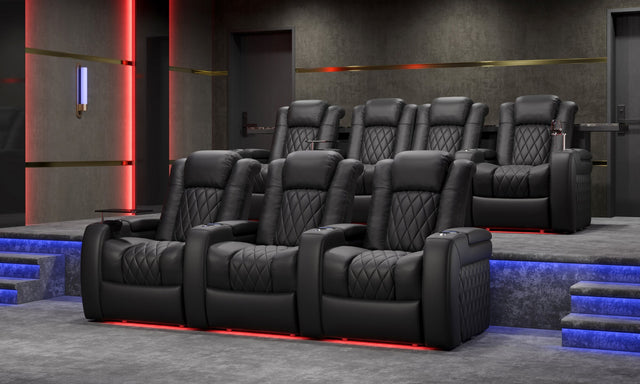
• Cinema-specific features: Built-in cup holders at the arm reach position, tray tables or snack trays, USB and wireless charging at seat level, and ambient LED base lighting designed to function without washing out a darkened projection screen. These features are standard at the theater tier and rare in living room recliners at any price point.
• Published dimensional specifications: Theater recliner manufacturers provide exact seat width, height, reclined depth, and row footprint dimensions so buyers and builders can design rooms around them. This precision does not exist in most furniture-grade recliners.
• Power headrest: Motorized headrest adjustment — moving the head support up or down independently of the backrest — is standard on premium theater models. It is uncommon in living room recliners outside the top tier of luxury brands.
Living room recliners are defined by:
• Orientation flexibility: Designed to work in any room layout and any viewing direction. No assumption about a fixed screen position.
• Living room aesthetic: Profiles and materials designed to integrate with sofas, coffee tables, and general furniture. Less visually dramatic than dedicated theater chairs.
• Standalone footprint: Sold as individual pieces. No shared armrests, no row coordination, no installation requirements beyond a nearby power outlet.
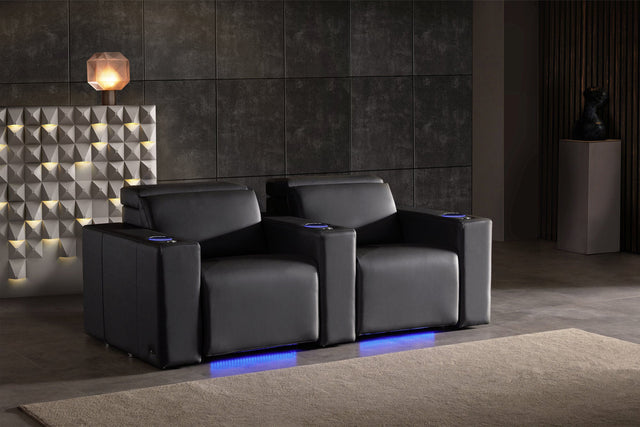
At the premium level, theater recliners in a standalone configuration (a single seat or a Row-of-2 placed as a sofa replacement) function equally well as living room recliners — particularly models like the Oslo and Barcelona Grand that have modern profiles appropriate for non-theater settings. The reverse is not reliably true: living room recliners placed in a theater setting typically lack the features that make the theater experience work well. See the full home theater seating collection for current theater recliner options.
3. Single Seat vs. Loveseat Configurations

The configuration choice — whether to buy individual seats or a loveseat/paired configuration — has more impact on the room's feel and functionality than most buyers anticipate. The floor plan math is intuitive; the comfort tradeoffs are less obvious.
Single seat configurations:
• Independent control: Each occupant adjusts their position, headrest, footrest, and seat heat or massage independently. There is no shared element between two viewers — each person has a completely personal experience.
• Individual armrests: Each seat has its own left and right armrest with independent cup holders, controls, and USB ports. Viewers do not share arm space.
• Flexibility: Single seats can be rearranged, added to incrementally, or separated into different rooms. A row of three single seats bought today can become two seats in one room and one seat in another if the household's needs change.
Loveseat and row configurations with shared console:
• Space efficiency: Two seats with a shared center console occupy less floor space than two independent chairs. The console replaces two interior armrests with one shared storage and charging unit, narrowing the total footprint by 6–10 in.
• Shared console benefits: A console configuration typically includes a dedicated storage compartment, multiple USB charging ports, a cup holder on each side, and sometimes a removable tray. This centralized feature placement is more convenient for couples who share the console space.
• Limitation: The shared console prevents the two occupants from moving their recline positions fully independently in some configurations. Verify whether the specific model's console version allows fully independent left and right recline control before purchasing.
When to choose a console configuration: When two people regularly watch together in a space-constrained room, and when the shared storage and charging convenience outweighs the minor reduction in individual positioning independence. For solo viewers or households with three or more regular viewers, individual seats with individual armrests offer more flexibility at equivalent total cost.
4. Wall-Hugger vs. Traditional Recliners

Wall clearance is a practical constraint that eliminates certain recliner types before any other comparison is made. Measure the distance from the back of your planned seat placement to the nearest wall, obstruction, or second-row seat back before evaluating any specific model.
Traditional recliners:
• How they recline: The backrest pivots backward and the footrest extends forward simultaneously. The seat's center of gravity shifts toward the rear as it reclines, pushing the back of the chair away from the starting position.
• Rear clearance required: 12–18 in behind the seat back in the upright position to reach full recline. In a 12 ft room with a seat positioned 12 ft from the screen, a traditional recliner placed with its back 6 in from the rear wall will not achieve full recline.
• Best for: Rooms where the seat back is at least 18 in from the nearest rear obstacle. This includes most center-of-room placements and most first-row positions in theater rooms with adequate depth behind the seating row.
Wall-hugger recliners:
• How they recline: The seat base slides forward as the backrest reclines — the opposite of traditional mechanisms. The chair moves into the room rather than back into the wall, requiring only 4–6 in of rear clearance in most models.
• Rear clearance required: 4–6 in from the seat back to the rear wall or obstruction. This makes wall-hugger mechanisms viable for rooms where seats must be positioned close to a rear wall, including second-row theater configurations placed at the back of the room.
• Consideration: The forward-sliding base means the viewer's position in the room shifts when reclining — the body moves approximately 10–14 in toward the screen. This slightly changes the viewing distance and angle from the upright position, which matters in precisely calibrated theater installations. For riser setups especially, verify that the fully reclined position stays within the riser platform and does not place the viewer's feet over the riser edge.
Practical rule: If the distance from the planned seat placement to the nearest rear wall or obstruction is less than 18 in, start with wall-hugger models. If the clearance is 18 in or more, traditional mechanisms offer slightly more recline travel and are generally available in more model options at each price point.
5. Leather Grade and Long-Term Value

Leather grade is the variable buyers most frequently underinvest in relative to its impact on long-term satisfaction. The price difference between leather grades at purchase can appear large; measured against the lifespan difference, it almost always reverses.
Bonded leather (avoid for primary seating): Made from leather scraps and fibers bonded together with polyurethane — essentially a leather-coated backing material. Bonded leather begins to peel, crack, and flake within 2–5 years under regular use. It looks like leather at the point of purchase and for the first year or two; after that it degrades faster than any other leather grade. Bonded leather is identifiable by price (unusually low for its apparent quality), by a plasticky surface feel, and by the absence of natural grain variation in the hide.
Genuine leather (entry-level real leather): The bottom layer of a hide after the surface has been sanded and coated. Genuine leather is real animal hide but is the least durable layer of the hide. It wears, scratches, and absorbs moisture more readily than higher grades. It is appropriate for accent use or low-use secondary seating but is not recommended as the primary material for a chair used daily.
Top-grain leather (the correct baseline for daily-use seating):
• What it is: The second layer of the hide, sanded to remove imperfections and then coated for consistency and durability. Top-grain is the industry standard for quality upholstered furniture — it is durable, cleanable, resistant to wear, and available in a consistent finish.
• Durability: 8–15 years of regular use under normal household conditions. The surface coating protects against moisture, oils, and light scratches.
• Feel: Firmer surface feel than full-grain or Nappa leather. Breaks in over the first 12–18 months of use and becomes noticeably softer. Does not have the pronounced natural grain of full-grain leather.
Italian Nappa leather (semi-aniline, the premium tier):
• What it is: Full-grain hide processed with minimal surface coating to preserve the natural grain and hand feel. Semi-aniline Nappa adds a light protective layer while retaining most of the tactile qualities of uncoated leather.
• Durability: 12–20+ years with proper care. More susceptible to initial surface marks than coated top-grain, but the material heals and develops a patina over time rather than showing irreversible damage.
• Feel: Noticeably softer and more supple than standard top-grain from the first use. Breathes better in warm conditions, reducing the warmth buildup common in coated leathers. For a full explanation of Italian Nappa's properties see What Is Italian Nappa Leather.
Bottom line on leather grade: Buy top-grain leather as your minimum for any recliner that will be used daily. The price premium over bonded leather is fully recovered within two years of extended lifespan. Upgrade to Italian Nappa on models where it is available if your sessions typically run 2+ hours — the breathability and softness difference becomes meaningful over long sessions in a way that is not obvious from a brief showroom test.
Frequently Asked Questions
How much should I spend on a good power recliner?
For a top-grain leather power recliner with a quality actuator mechanism, budget $800–$1,500 per seat. Under $600, you will typically find bonded leather or genuine leather with less durable mechanisms. Above $1,500, you are paying for Italian Nappa leather, additional powered features (headrest, lumbar, heating, massage), and premium frame construction. The sweet spot for most buyers is the $1,000–$1,400 range where top-grain leather, power recline, and basic theater features overlap. See the Home Theater Budget Guide for seating cost in the context of a full room budget.
What is the difference between a power recliner and a power lift recliner?
A power recliner adjusts the backrest and footrest to change the seated position. A power lift recliner adds a full seat-tilt mechanism that raises the entire chair forward to assist the occupant in standing up — primarily designed for users with mobility limitations. Theater recliners are power recliners, not lift chairs. If standing assistance is a requirement, verify that the specific model includes a lift function, as most theater models do not.
How do I know if my recliner will fit in the room?
Measure three dimensions: the space's total width available for seating, the depth from the front planned seat position to the nearest rear wall or obstruction, and the clearance from the floor to any overhead obstruction (important only for very high-back models or riser installations). Compare these against the manufacturer's published dimensions for the model in both the upright and fully reclined position. The reclined depth is the most commonly overlooked measurement — always verify it before purchasing. The Layout and Row Spacing Guide has a full room-fitting calculation framework.
Is heated seating worth the upgrade?
Heated seating is worth the upgrade for buyers in colder climates, for rooms that are difficult to heat evenly, or for anyone who finds they frequently use a blanket while seated. The heating element warms the seat cushion and lumbar area — not the full room — which makes a noticeable difference in rooms that run cool during evening viewing sessions. The heating function draws minimal power (typically 30–60W per seat) and adds $100–$200 to the per-seat cost depending on the model.
How long does a power recliner motor last?
Quality linear actuators used in premium recliner mechanisms are rated for 10,000–50,000 cycles depending on the manufacturer's specification. At two full recline-and-return cycles per day, that equates to 13–68 years of motor life under normal use. The limiting factor in power recliner longevity is almost never the motor — it is the leather, the foam density, and the frame. Prioritize those three material elements over motor cycle ratings when evaluating durability.
What is the best recliner for tall people?
Tall viewers (over 6 ft 2 in) should prioritize: a power headrest that adjusts vertically to reach the correct cervical support position, a seat depth that supports the full thigh length when reclined, and a footrest that extends far enough to support the lower leg without the calves resting on the footrest edge. The Barcelona Grand XL and Tuscany Ultimate with power headrest both address tall-viewer fit directly. For tall-viewer specific guidance see the How to Choose Home Theater Seats guide.
How do I clean and maintain a leather recliner?
Top-grain leather: wipe spills immediately with a dry cloth, clean periodically with a mild leather cleaner (pH-neutral, no solvents), and condition every 6–12 months with a leather conditioner appropriate for coated top-grain. Avoid direct sunlight exposure, which accelerates fading and drying. Italian Nappa leather requires more frequent conditioning (every 3–6 months) and more careful spill management due to its lighter surface coating. For a full maintenance protocol see the How to Clean and Care for Leather Furniture guide in the knowledge center.
What is the difference between a recliner and a theater seat?
The core difference is design intent: a theater seat is engineered for a fixed-screen viewing context in a row configuration, with features (LED lighting, cup holders, USB charging, power headrest) that serve a cinema experience. A recliner is engineered for individual comfort in any room orientation. At the premium end, these categories overlap substantially — a theater seat used as a standalone recliner delivers better feature density than most recliners at the same price point. The full comparison is covered in the Theater Seating vs. Recliners guide.