

In this article: Everything that matters when buying a recliner — power vs. manual, features worth paying for, sizing, wall clearance, and material quality — so you get it right the first time.
- Power vs. Manual Recline
- Features Worth Paying For
- Single Chair vs. Loveseat
- Wall-Hugger vs. Standard Mechanism
- How to Size a Recliner
- Leather Grade and Material Quality
- Frequently Asked Questions
A recliner is one of the few furniture purchases that directly affects your physical comfort every day — and buying the wrong one is a mistake you'll feel for years. Most people spend more time researching a phone than a chair they'll sit in for thousands of hours.

This guide covers every decision that actually matters — the mechanism, features, configuration, clearance requirements, and materials. If you're choosing seats specifically for a home theater, also see How to Choose Home Theater Seats for room-specific guidance.
Quick Takeaways
• Power recline opens the door to every premium feature.
Heat, massage, power headrest, and power lumbar all require an electric motor foundation.
• A wall-hugger mechanism is non-negotiable within 12 inches of a wall.
Standard mechanisms need 10–16 inches of rear clearance — wall-hugger needs 3–4 inches.
• A loveseat with center console is the most space-efficient solution for two people.
Two power recliners share armrests, a cup holder console, and USB ports in a single footprint.
• Full-grain Italian leather holds up for 10–15 years with light maintenance.
Bonded leather begins delaminating in 3–5 years — not a long-term investment.
• Measure reclined depth before buying.
Most recliners extend 20–30 inches forward when fully open — the room needs that space.
1. Power vs. Manual Recline

Manual recline uses a side lever or push-back mechanism. It's simple, has no electronics to fail, and costs less. For occasional use in a bedroom or living room where you're moving in and out frequently, manual is fine.
Power recline uses an electric motor controlled by a button or remote. The footrest and backrest move independently, so you can dial in any position — not just the lever's preset angle. Power is also the gateway mechanism: every premium feature (heat, massage, power headrest, power lumbar, USB) requires a power foundation. There is no heated-and-massaging manual recliner.
| Consideration | Manual | Power |
|---|---|---|
| Mechanism | Lever or push-back | Electric motor, button/remote |
| Position control | Preset stops | Infinite positions |
| Premium features | Not available | Heat, massage, headrest, lumbar |
| Wall clearance | 12–16 in. (standard) | 3–6 in. (wall-hugger models) |
| Best use case | Occasional use, budget-focused | Daily use, long sessions, HT rooms |
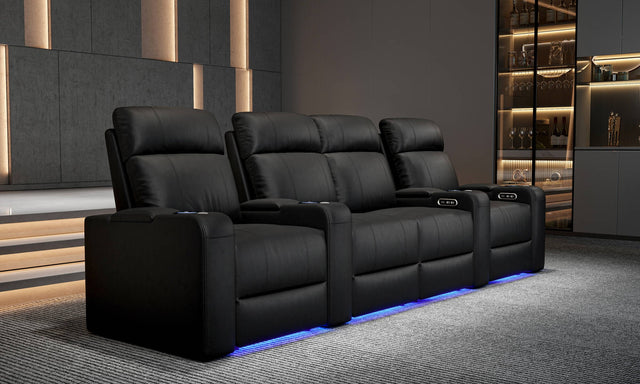
For any dedicated home theater, media room, or daily-use recliner, power is the right choice. The features it enables — especially heat and power headrest — are the ones you'll use in every session once you have them.
2. Features Worth Paying For

Not every feature on a power recliner is worth the upgrade. Here's an honest assessment of which ones earn their cost through daily use:
• Power headrest — adjusts the headrest independently of the backrest, keeping your neck at a comfortable angle at any recline position. Critical for watching content for more than an hour. High daily use value.
• Power lumbar — adjusts the lower back support per-user, not just per-model. Valuable if multiple people use the chair with different back profiles, or if you have lower back sensitivity.
• Heat — distributes warmth through the leather seat and back. The feature people are most surprised by — once you have it, you use it in nearly every session. High daily use value.
• Massage — vibration motors in the seat and back for relaxation. Not therapeutic in the medical sense, but effective for unwinding. Use varies by person — some use it constantly, some rarely.
• USB charging — built-in USB ports in the armrest or console. Practically useful, but not a reason to choose one chair over another.
• LED lighting — ambient lighting under the chair or around the base. Primarily aesthetic for home theater environments, provides useful navigation lighting in dark rooms.
For a full breakdown of what each feature does and costs, see Home Theater Seating Features That Actually Matter.
3. Single Chair vs. Loveseat

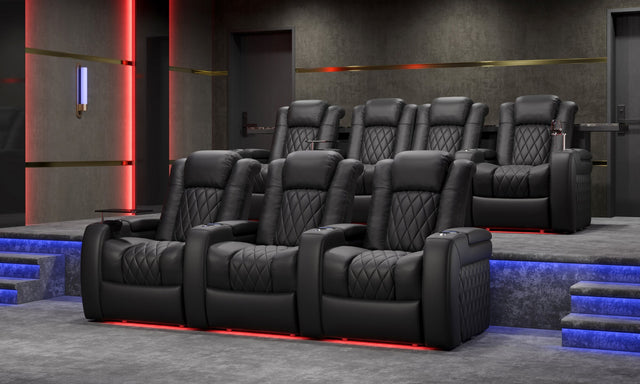
A single recliner occupies its own footprint. A loveseat pairs two recliners — each with independent recline control — separated by a shared center console with cup holders, storage, and often USB ports.
The loveseat is almost always the better choice when two people will use the space regularly:
• Space efficiency — two chairs sharing a center console use 15–20% less floor space than two independent chairs with their own full armrests.
• Independent recline — both occupants control their own position, footrest, and features independently. There's no mechanical link between the two sides.
• Integrated amenities — the center console brings cup holders, storage, and USB to both occupants without a separate side table.
• Sofa replacement — in living rooms or media rooms, a power loveseat replaces a standard sofa with better ergonomics and more functionality.
The only scenario where two singles beat a loveseat: when the chairs will be placed in separate locations, or when the room configuration requires independent positioning on opposite sides of the space.
4. Wall-Hugger vs. Standard Mechanism

This is the most practically important spec that most buyers don't check until the chair is in the room.
A standard recliner mechanism pushes the backrest backward as it reclines, requiring 10–16 inches of clearance behind the chair. A wall-hugger mechanism slides the seat forward as the backrest reclines, requiring only 3–6 inches of rear clearance.
| Mechanism | Rear Clearance | Best For |
|---|---|---|
| Standard | 10–16 inches | Rooms with dedicated floor plan, seating away from walls |
| Wall-Hugger | 3–6 inches | Against or near walls, tight floor plans, apartment living rooms |
If the chair will be placed within 12 inches of any wall, a wall-hugger mechanism isn't a convenience — it's a requirement. A standard mechanism pushed against a wall simply will not recline to its full range.
For home theater rows, the rear-row chair often sits against or near the back wall. This is one of the reasons platform risers are commonly used — raising the rear row creates floor clearance that wall-hugger mechanisms require. See Do You Need a Theater Riser for how riser height affects rear-row clearance.
5. How to Size a Recliner

Recliners look smaller in showrooms than in your home. Measure before buying — every time, without exception.
Three measurements matter:
• Upright width — the full width including armrests, measured at the widest point. Most standard recliners are 30–36 inches; XL models run 36–42 inches.
• Upright depth — front of footrest to back of backrest when fully upright. Typically 36–42 inches.
• Reclined total depth — depth when fully reclined. Standard recliners extend 20–30 inches forward from their upright footprint. This is the measurement most people miss: the chair needs that space in front of it to open fully.
Measure the available floor space for the reclined footprint, not just where the chair will sit upright. For a theater row, check that the reclined depth of the front row doesn't reach the seating position of the second row — typically you want 18–24 inches of clearance between the front row's reclined footrest and the second row's seat front. For full spacing guidelines, see the Layout & Row Spacing Guide.
6. Leather Grade and Material Quality

Leather grade determines how long the chair looks and feels good — and how it responds to heat and daily contact over years of use.
• Full-grain Italian leather — the outermost layer of the hide, unaltered. Develops a patina over time, breathes naturally, and resists wear for 10–15 years with light conditioning. This is the material used in premium theater seating and high-end furniture.
• Top-grain leather — sanded and treated to remove natural imperfections. More uniform appearance, slightly less durable than full-grain over long terms. A solid mid-range choice.
• Split-grain leather — the inner layers of the hide, usually coated or embossed to mimic top-grain. Noticeably lower durability; begins to crack and peel within 5–7 years of daily use.
• Bonded leather — leather scraps or dust bonded with polyurethane. Looks like leather initially but delaminates and peels in 2–4 years. Not a long-term investment regardless of price point.
For a home theater recliner used multiple times per week, the practical minimum is top-grain leather. Full-grain Italian leather — specifically Italian Nappa — is the correct material for a chair expected to hold up for a decade. For a detailed look at what sets Italian Nappa apart, see What Is Italian Nappa Leather.
Frequently Asked Questions
What is the most important feature in a recliner?
For daily use and long sessions, power headrest has the highest practical impact. Maintaining proper neck angle regardless of recline position eliminates the neck strain that plagues people in fixed-headrest chairs. After that, heat is the feature most people say they can't do without once they've used it regularly. For a full feature-by-feature breakdown, see Home Theater Seating Features That Actually Matter.
Is a power recliner worth the extra cost over manual?
Yes, for any chair that will see daily use or long sessions. The infinite position control alone justifies the cost — but more importantly, power is the required foundation for heat, massage, power headrest, and power lumbar. A chair used 300+ times per year without those features is a missed investment. The cost difference between power and manual at the same quality tier is typically $200–$400.
How do I know if I need a wall-hugger mechanism?
Measure the distance from the back of where the chair will sit to the wall behind it. If it's less than 12 inches, you need a wall-hugger. Standard mechanisms require 10–16 inches of clearance to fully recline. At 6 inches or less of clearance, even a wall-hugger model may have limited range — check the product spec sheet for the exact clearance requirement.
What's the difference between a recliner and a home theater seat?
Home theater seats are recliners designed for row configurations — they link together, have cup holders and tray tables integrated, and are scaled and contoured for long movie-watching sessions rather than general living room use. They tend to be wider, have more supportive foam profiles, and are built for multi-seat layouts. For a detailed comparison, see Theater Seating vs. Recliners.
How long should a quality recliner last?
A well-built power recliner in full-grain leather, used daily, should last 10–15 years before the material or mechanism shows significant wear. Foam density matters for longevity — high-density foam retains its support; lower-density foam begins to sag in 3–5 years. Motors and electronics are replaceable if needed; the frame and foam are the limiting factors. Bonded or split-grain leather will fail well before the frame does.
Can I put a recliner directly against the wall?
Only with a wall-hugger mechanism. Even then, leave 3–4 inches minimum for the mechanism to slide the seat forward as it reclines. Placing a standard-mechanism recliner directly against the wall will prevent it from reclining fully and puts mechanical stress on the chair over time. The Layout & Row Spacing Guide covers clearance requirements for all row configurations.
What leather grade should I look for in a recliner?
For a daily-use recliner, full-grain or top-grain leather is the practical minimum. Full-grain Italian leather — the unaltered outer hide layer — is the most durable and develops a patina rather than degrading. Avoid bonded leather at any price point; it delaminate and peels within 2–4 years. For more on material grades and what sets Italian leather apart, see What Is Italian Nappa Leather.
How do I choose the right size recliner for my room?
Measure the reclined total depth first — this is the footprint that matters for room planning. Most recliners extend 20–30 inches forward when open, so the available floor space in front of the chair must accommodate this. Also check upright width (typically 30–36 inches for standard, 36–42 for XL) and wall clearance. If you're planning a theater row, the How Many Seats Do You Need guide covers row configurations and spacing.